Relationship Counseling: The Complete Guide
What relationship counseling covers, how it differs from couples therapy and marriage counseling, what sessions involve, formats, cost and free options.
Relationship counseling is the broad umbrella for talking to a trained professional about any relationship that matters to you. Most people meet the idea through couples on the brink of a breakup, but the reality is far wider: dating partners deciding whether to commit, engaged couples untangling money or family expectations, married partners rebuilding trust, adult siblings, parents and grown children, co-parents after a separation, even close friends or business partners whose bond has frayed. If two or more people share a connection worth protecting, there is a form of relationship counseling built for it. This guide explains what it is, how it differs from couples therapy and marriage counseling, what actually happens in a session, what it costs, and how to choose someone good.
The short version
- Relationship counseling is the umbrella term. It covers any relationship, not only romantic partners or married couples.
- Couples therapy and marriage counseling sit underneath it. They are specific applications of the same broad idea.
- You do not need to be in crisis. Many people go to strengthen a good relationship or navigate a big decision.
- You can go alone. Individual counseling for a relationship issue is common and often useful when only one person is ready.
- It comes in many formats: in person, online, short-term or ongoing, paid or free through charities and helplines.
What relationship counseling actually is
At its simplest, relationship counseling is a structured conversation guided by a trained, neutral professional whose job is to help the people involved understand what is happening between them and change unhelpful patterns. It draws on the same foundations as psychotherapy more broadly: regular personal interaction, established psychological methods, and a focus on changing behavior, easing distress and improving how people relate to one another. The difference is the unit of attention. Instead of one person's inner world, the relationship itself, the space between people, is what sits in the room.
That framing is why the umbrella stretches so far. A dating couple deciding whether they want the same future, two co-parents who can no longer be in a room without conflict, and an adult child trying to repair a strained tie with a parent are all working on a relationship, so all three fit under relationship counseling even though none of them is a married couple in the classic sense. The counsellor stays neutral, does not take sides, and works for the health of the bond rather than for either individual against the other.
Umbrella term versus couples therapy and marriage counseling




The three phrases get used interchangeably, and often that is harmless, but there are real distinctions worth knowing before you book anything. Think of relationship counseling as the widest circle, with the others nested inside it.
Relationship counseling
The broadest term. Any relationship, romantic or not, and often a shorter, skills-focused, present-day approach. The umbrella over everything below.
Couples therapy
Specifically two partners in an intimate relationship. Often goes deeper into emotional patterns and history. Our full explainer covers what happens inside couples therapy.
Marriage counseling
Couples therapy framed around a marriage specifically, sometimes with pre-marital or faith-based angles. See our guide to marriage counseling.
Couples counseling
Often used as a gentler synonym for couples therapy, leaning practical and communication-focused. Compared side by side in our piece on couples counseling.
Two practical distinctions matter more than the labels. First, scope: only relationship counseling comfortably covers non-romantic bonds like family, co-parents or friends. Second, depth and duration: "counseling" often signals a shorter, more solution-focused piece of work anchored in the present, while "therapy" can signal a longer arc that explores emotional and historical roots. In practice the same professional may offer both, and the words on their website matter less than the fit you feel in the first session.
Everything is a form of relationship counseling. Couples therapy, marriage counseling and the rest are specific rooms inside the same house.
Who it is for, and why people go
The most common misconception is that counseling is a last resort you reach for only when a relationship is already failing. Plenty of people arrive in crisis, but plenty more come for ordinary, forward-looking reasons: to make a good relationship stronger, to prepare for a big change, or to learn how to argue without wounding each other. Going early, while there is still goodwill in the room, tends to make the work easier, not harder.
Dating and new couples
Deciding whether to commit, aligning on values, or breaking a repeating conflict before it hardens.
Engaged and pre-marital
Money, in-laws, children, faith and expectations, worked through calmly before the wedding rather than after.
Married partners
Rebuilding trust after a breach, reconnecting after drifting apart, or navigating a life shock together.
Families and co-parents
Adult siblings, parents and grown children, or separated co-parents learning to cooperate for the kids.
Individuals
One person working on their part of a relationship, common when a partner is unwilling or unavailable.
Anyone stuck in a pattern
The same fight on a loop, growing distance, or a decision you keep circling without resolving.
Which type of counseling fits your situation
If you are unsure which door to walk through, this table maps common situations to the form of counseling that usually suits them. Treat it as a starting point, not a rule. A good practitioner will help you adjust once they understand your circumstances.
| Your situation | Usually the best fit | Why |
|---|---|---|
| Dating and deciding whether to commit | Relationship counseling or couples counseling | Present-focused, practical, no assumption of marriage. |
| Engaged, sorting out expectations | Marriage counseling (pre-marital) | Built to surface money, family and future issues before the wedding. |
| Married, deep or long-running distress | Couples therapy | Goes into emotional patterns and history, not just surface skills. |
| Married, want a tune-up or better communication | Marriage counseling or couples counseling | Shorter, skills-focused work to strengthen a workable relationship. |
| Strained bond with a parent, sibling or adult child | Family counseling | Designed for relatives and family systems, not romantic pairs. |
| Separated but raising children together | Co-parenting counseling | Focuses on cooperation and the children rather than the relationship. |
| Your partner will not attend | Individual counseling for a relationship issue | You can change your own part of a pattern on your own. |
| A friendship or business partnership has frayed | Relationship counseling | The umbrella term stretches to non-romantic bonds too. |
What actually happens in a session
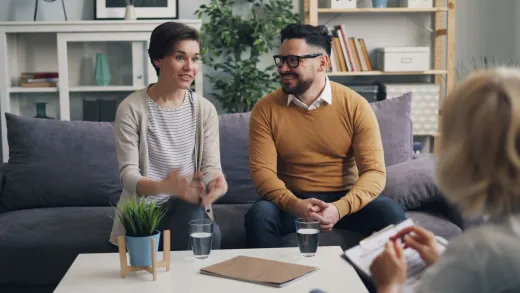
The mechanics are far less intimidating than most people expect. A first session is usually an assessment: the counsellor asks what brought you in, hears each person's version, and starts to map the pattern between you. There is no shouting match refereed by a stranger, and a good counsellor will not let sessions become one. Their job is to slow the conversation down enough that both people can actually be heard.
From there the work depends on the approach. Some counsellors, drawing on established couples therapy methods such as emotionally focused therapy or the Gottman method, help partners notice the emotional cycle underneath their arguments, the attachment fears and reactions that drive the same fight again and again. Others stay more practical, teaching concrete communication and repair skills you practise between sessions. When wider family relationships are involved, the counsellor may lean on family therapy techniques that look at the whole system of relationships rather than any single person's behavior. Most courses of counseling run somewhere between a handful and twenty sessions, spaced a week or two apart, with a clear sense of what you are working toward.
Formats: in person, online, together or alone
How you attend matters almost as much as who you see, because the format has to fit your life or you will not keep going. There are three choices to make, and none of them has a single right answer.
In person
Traditional face-to-face sessions in a private room. Many people find the shared physical space steadying and easier for reading each other.
Online
Video or phone counseling from home. Convenient, often cheaper, and a lifeline for rural areas, busy schedules, disability or long-distance couples. Recognised as a legitimate delivery format for psychotherapy.
Together
Both partners, or several family members, in the room at once. The default when everyone is willing and safe to attend.
Individual for a relationship issue
You attend alone to work on a relationship. Useful when a partner refuses, when you want to understand your own patterns, or as a first step toward joint sessions later.
Individual counseling on a relationship deserves special mention because so many people assume they cannot start without their partner. You can. Changing your half of a repeating dynamic often shifts the whole pattern, and it can be the thing that eventually brings a reluctant partner to the table. If both of you are willing, joint sessions are the usual route, but a one-sided start is far better than no start.
What it costs, and the free options
Cost is the most common reason people put off getting help, so it is worth being clear-eyed. Paid private sessions vary widely by country, city and the practitioner's experience, and they are usually priced per session lasting roughly fifty to ninety minutes. Online and video sessions tend to sit at the lower end, while highly experienced specialists in expensive cities sit at the top. Some counsellors offer a sliding scale based on income, and some health plans, employers or student services cover a set number of sessions, so it is always worth asking before you assume you cannot afford it.
Free and low-cost help is more available than most people realise. Community and family service charities often run relationship and family counseling on a donation or sliding-scale basis. Faith organisations, universities and colleges frequently offer counseling to their communities. Employee assistance programmes bundled with a job commonly include a handful of free confidential sessions. Training clinics, where supervised counsellors-in-training see clients, offer substantially reduced fees. And national relationship charities and helplines provide free information, phone support and, in some places, subsidised sessions.
General information, not professional advice: this guide explains how relationship counseling works so you can make an informed choice. It is not a substitute for care from a qualified counsellor, therapist or doctor, and it cannot assess your specific situation. If you are in emotional distress, or if there is any abuse or fear for your safety in a relationship, contact a professional or a helpline now. In an immediate crisis or if anyone is in danger, call your local emergency number, or a crisis line such as 988 in the United States, 111 in the United Kingdom, or the emergency number for your country.
How to choose a counsellor
The single biggest predictor of whether counseling helps is the fit between you and the professional, not the brand name of their method. That said, a few checks stack the odds in your favour before you ever book.
Check the credentials
Look for training and registration with a recognised professional body for counselling, psychotherapy or marriage and family therapy in your country.
Match the specialism
A counsellor experienced in your issue, infidelity, co-parenting, pre-marital, blended families, will move faster than a generalist.
Ask about cost up front
Confirm the fee, session length, whether a sliding scale exists, and what insurance or employer schemes they accept.
Weigh the first session
Did you both feel heard and unjudged? Neutrality and comfort matter more than any qualification on the wall.
Confirm safety and neutrality
A good counsellor takes no side and screens for abuse. If a relationship is unsafe, joint sessions may not be appropriate.
Be ready to switch
If it does not click after two or three sessions, changing counsellor is normal and sensible, not a failure.
Once you have narrowed the type of help you want, our focused guides go deeper on each: what to expect from couples therapy, how marriage counseling approaches a marriage specifically, and how couples counseling compares as a more practical, skills-first option.
Getting started
You do not need a diagnosis, a crisis or your partner's permission to begin. You need a relationship you care about and enough honesty to admit the current pattern is not working. Decide roughly what you want help with, choose a format that fits your life and budget, and book a first session with someone whose training and focus match your situation. If the fit is right, you will feel it early. If money is the obstacle, start with the free and low-cost routes rather than waiting. The best time to strengthen a relationship is while there is still goodwill in the room, which usually means sooner than you think.
Frequently asked questions
What is the difference between relationship counseling and couples therapy?
Relationship counseling is the broad umbrella term for professional help with any relationship, romantic or not, including dating partners, married couples, families, co-parents and even friends. Couples therapy is a specific application of it, focused on two people in an intimate relationship and often exploring emotional patterns and history more deeply. In everyday use the phrases overlap heavily, and the same professional may offer both. The practical differences are scope, only relationship counseling comfortably covers non-romantic bonds, and depth, "therapy" often signals longer, more exploratory work than "counseling."
Can I go to relationship counseling alone?
Yes. Individual counseling for a relationship issue is common and often useful, especially when a partner is unwilling or unavailable to attend. Working on your own half of a repeating dynamic, understanding your reactions and changing your responses, can shift the whole pattern between you and sometimes brings a reluctant partner to join later. Joint sessions are the usual route when both people are willing, but a one-sided start is far better than not starting at all.
How much does relationship counseling cost, and are there free options?
Private sessions are usually priced per session and vary widely by country, city and the counsellor's experience, with online sessions often cheaper than in person. Some counsellors use a sliding scale, and some health plans or employers cover a set number of sessions. Free and low-cost help genuinely exists: community and family service charities, faith organisations, university services, employee assistance programmes, and supervised training clinics all offer reduced-fee or free counseling. National relationship charities and helplines also provide free information and phone support.
Is online relationship counseling as effective as in person?
For many people it works well. Online and telephone counseling is a recognised, legitimate way of delivering psychotherapy, and it removes practical barriers of travel, cost, scheduling, disability and distance that stop people getting help at all. Some couples prefer the steadying shared space of an in-person room, particularly for high-conflict or highly emotional work. The format that matters most is the one you will actually keep attending, so choose based on your life, your comfort and the counsellor's fit rather than assuming one is always better.
How do I know if we need counseling?
You do not have to be in crisis to benefit. Common signs are the same argument returning on a loop, a quiet loss of closeness, a specific event that has knocked the relationship off balance, or a big decision you keep circling without resolving. Many people also go simply to strengthen a good relationship or prepare for a change like marriage or a new baby. Going early, while there is still goodwill, tends to make the work easier. If there is any abuse or fear for your safety, seek professional help or a helpline rather than joint sessions.
Does relationship counseling only work for romantic couples?
No, and that is the point of the umbrella term. Relationship counseling covers any bond worth protecting: parents and adult children, siblings, separated co-parents raising kids together, close friends, and even business partners, alongside dating, engaged and married couples. When wider family relationships are involved, counsellors often draw on family therapy approaches that look at the whole system of relationships rather than any single person. If a relationship matters to you and the pattern is not working, there is a form of counseling built for it.