Wedding Organiser: The Complete Guide
Your organiser is the single home for the budget, guest list, vendors, timeline, seating and day-of run sheet, plus a note on the British term for a planner.
Every calm couple has the same secret, and it is not a bigger budget or a better memory. It is a single place where the whole wedding lives: the numbers, the names, the contracts, the dates and the order of the day, all in one home that both of them trust. That home is your wedding organiser. The word carries two meanings, and this guide covers both. To most couples an organiser is the system that holds the plan together, a binder or an app or a spreadsheet. In Britain the same word is also the everyday name for the professional the rest of the world calls a planner. Here is how to build the first kind, how it differs from the second, and how to keep it working from the engagement to the aisle.
The short version
- An organiser is one home for the plan. Budget, guests, vendors, timeline, seating and day-of, all in one place.
- The word has two meanings. The system you keep, and, in the UK, the person you hire.
- Sections beat features. A good organiser is defined by what it holds, not by which app it runs in.
- Maintenance is the whole point. An organiser you do not update is just an expensive drawer.
What a wedding organiser actually is
A wedding organiser, in the sense most couples mean, is the master system that holds every moving part of the wedding in one structured place. It is not a single product. It is a set of sections, a budget, a guest list, a vendor file, a timeline, a seating plan and a day-of run sheet, kept together so that any question about the wedding has exactly one place to be answered. Whether those sections live in a leather binder, a phone app or a shared spreadsheet matters far less than the fact that they live together and stay current. The organiser is the shape of the plan, not the material it is printed on.
Think of it the way a project manager thinks of a plan. A wedding is a one-off project with a fixed deadline, dozens of dependencies and two people running it for the first time. Formal event management handles exactly this kind of work by applying project discipline to the creation of an event: budgeting, scheduling, site selection, transport, vendor coordination and contingency plans. Your organiser is the domestic version of that discipline. It does not need to be elaborate. It needs to be complete and current, so that nothing important is being carried only in one person's head.
The British term: organiser as a synonym for planner


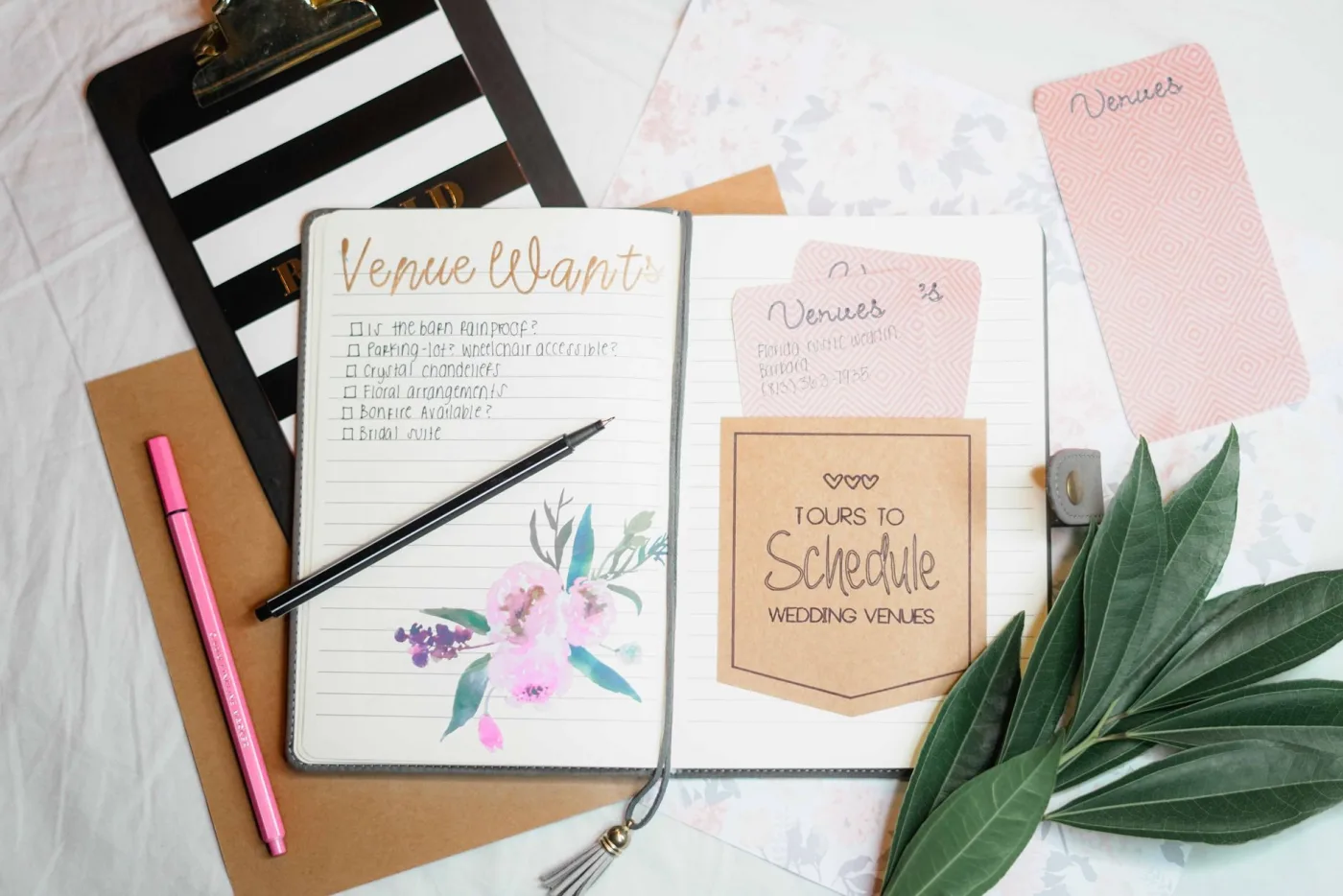
There is a second meaning worth clearing up early, because it changes what you find when you search. In British and Commonwealth English, a wedding organiser is very often a person, not a binder. It is the everyday word for what the trade formally calls a wedding planner: a professional who manages the design, planning and coordination of the day, and who is also known as a consultant, designer, coordinator or director depending on the firm. So "wedding organiser" can mean the system you keep yourself, or the specialist you pay to keep it for you.
The distinction matters for a practical reason. If you are looking to build your own system, this guide is for you. If you are weighing whether to hand the whole job to a professional, that is a different decision with its own trade-offs, and our guide to hiring a wedding planner breaks down the levels of service and what each tier is worth. The rest of this article treats the organiser as your own system, because even couples who hire a professional still keep a personal budget and guest list of their own.
The sections your organiser needs
A complete organiser is defined by its sections. Get these six right and the container barely matters. Each one answers a different recurring question, and each one has a natural owner and a natural format. The table below is the skeleton to build against, whether you are labelling tabs in a binder or naming tabs in a spreadsheet.
| Section | Answers the question | What it holds | Best format |
|---|---|---|---|
| Budget | Can we afford this? | Estimated and actual costs, deposits paid, balance owed | Spreadsheet |
| Guest list | Who is coming? | Names, sides, invites sent, RSVPs, meal choices | Spreadsheet |
| Vendors and contracts | Who is doing what, for how much? | Signed contracts, quotes, payment dates, contact details | Binder plus a list |
| Timeline and tasks | What is due, and when? | The full task checklist keyed to your date, with deadlines | App or shared list |
| Seating plan | Where does everyone sit? | Tables, place assignments, dietary and access notes | App or spreadsheet |
| Day-of run sheet | What happens on the day? | Minute-by-minute schedule, vendor slots, contact sheet | Shared document |
Notice that the six sections do not all want the same format, which is the single most useful thing to understand about organisers. The budget and guest list are number work that a spreadsheet does better than anything. The contracts are paper that a binder holds better than a screen. The tasks want reminders that only an app gives you. A good organiser is usually not one tool but the right tool per section, tied together by the rule that each section has exactly one home.
Binder, app or spreadsheet: the three containers
Underneath the sections sit three broad container types, and most couples end up combining two or three of them rather than choosing one. Here is what each is genuinely good at, and the kind of person it suits.
The physical binder
A bound book or ring binder with tabbed sections and pockets. Tactile, offline, never loses battery, and doubles as a keepsake. Best for contracts, swatches and couples who think on paper.
The wedding app
A phone or web app with a prebuilt checklist, push reminders and digital RSVP links. Best for deadlines and guest replies, the two jobs paper is worst at. Weaker for a bespoke budget.
The spreadsheet
Your own columns and formulas in a shared sheet. Unbeatable for the budget and the guest list, live-editable by both partners, and free. Does nothing you do not tell it to, including reminding you.
None of these is the correct answer on its own, and the couples who struggle are rarely the ones who picked the wrong container. They are the ones who picked three and kept each half-updated. The winning pattern for most couples is a shared spreadsheet for the budget and guest list, one app for tasks and reminders, and a slim binder for the paperwork you like to hold. If you want the long-form comparison of these systems on the jobs that matter, our guide to wedding planning tools lays them out side by side, column by column.
The organiser is the spine, not the paper. Six sections bound together, each with one home and one owner.
Building each section, in order
An organiser is built in a sensible sequence, because the later sections depend on the earlier ones. You cannot plan a seating chart before you have a guest list, and you cannot set a budget line for the caterer before you know roughly how many mouths there are. Build them in this order and each one feeds the next.
Budget: the section everything answers to
Start here, because every other decision is really a budget decision in disguise. Build a spreadsheet with a row per category and columns for estimated cost, actual cost, deposit paid and balance owed, then let a formula show the running total and what is left the instant you type a number. In the United States the average wedding draws close to seventy million guests across roughly two million events each year, which tells you how large and normalised this spending is, and how easy it is to drift over budget without a live total in front of you. The budget is the one section that should never be more than a click away.
Guest list: the number that drives the cost
The guest list is the hidden lever behind the whole budget, because almost every large cost, the catering, the venue, the invitations, the favours, scales with the headcount. Give it columns for name, side, address, invite sent, RSVP, meal choice and table, all sortable and filterable. Keep exactly one copy. The single most common planning failure is two slightly different guest lists, so the caterer gets one number and the seating plan is built on another. Decide where this list lives on day one and never let a second version start.
Vendors and contracts: the paper section
This is where a binder earns its keep. Every vendor, the venue, caterer, photographer, florist, band, officiant, should have a signed contract, a note of what is included, the payment schedule and a direct contact number. Paper contracts, printed quotes to compare, and business cards all belong in a physical pocket you can carry to a meeting. Alongside the paper, keep a simple list in your organiser of who is booked, how much is owed and when the next payment falls due, so a forgotten balance never becomes a crisis.
Timeline and tasks: the section with a clock
This section is the long checklist of everything that must happen before the day, keyed to your date and broken down by how many months out each task falls. It is the one section that genuinely benefits from an app, because tasks have deadlines and an app can remind you of them where a binder cannot. Rather than build this list from scratch, start from a proven one: our step-by-step wedding planning checklist gives you the full sequence of tasks by timeline, which you can drop straight into your app or sheet as the backbone of this whole section.
Seating plan: the puzzle near the end
Seating comes late because it depends on final RSVPs, and it changes right up to the last week. Keep it flexible: a grid of tables with names you can move around, plus a note against anyone with a dietary need or an access requirement, and a quiet flag on the pairs of guests who should not share a table. Because it flexes so late, this section wants a digital home you can rearrange in seconds, not a hand-drawn chart you have to redraw every time an RSVP changes.
Day-of run sheet: the section for the day itself
The final section is a minute-by-minute schedule of the wedding day: what happens, when, and who is responsible for each item, from vendor load-in through the ceremony, speeches, first dance and send-off. This is the bridge between planning and execution, and it deserves its own attention, because a beautifully organised plan does not run itself on the day. How that run sheet is used to actually run the event, and who should hold it, is the subject of our guide to wedding management, which covers the on-the-day discipline your organiser feeds into.
The one rule that beats every tool: one home and one owner per section. Each of the six lists lives in exactly one place, and one of you is named as the person who keeps it current. The organiser fails not when a section is missing a clever feature, but when two copies of a list drift apart, or when a section belongs to nobody and quietly goes stale. Decide the home and the owner on day one, and say both out loud so you each mean it.
Keeping the organiser maintained
An organiser is only as good as its last update, and this is where most systems quietly fail. A binder started with enthusiasm in month one becomes a museum piece by month six if nobody adds to it. The fix is not more discipline, it is a small routine that makes updating automatic rather than heroic. Set a standing weekly slot, fifteen minutes is plenty, where the two of you open the organiser together and touch every live section.
- Reconcile the budget. Enter any new deposits or payments so the running total is always true, never a week behind reality.
- Update RSVPs. Move any new replies into the guest list the moment they arrive, so the count is never carried in your inbox.
- Clear the task list. Tick off what is done, and read the next month's tasks so nothing sneaks up on you.
- File the paper. Any new contract or quote goes straight into the vendor section that week, not into a pile for later.
- Check the next payment. Glance at which vendor balance is due next, so a deadline is never a surprise.
That short weekly pass is the entire maintenance job, and it is the difference between an organiser that carries you to the day and one that becomes another thing to feel guilty about. The couples who arrive at their wedding calm are almost never the most naturally organised. They are the ones who picked a system early, gave every section one home and one owner, and spent a quiet quarter of an hour a week keeping it honest.
Build it in that spirit and the container becomes almost irrelevant. Binder, app or spreadsheet, the organiser is really just the promise that no decision falls through the cracks while the two of you make the ones that matter.
Frequently asked questions
What is a wedding organiser?
A wedding organiser is the master system that holds every part of your wedding in one structured place: the budget, guest list, vendors and contracts, timeline, seating plan and day-of run sheet. It is not one specific product, but a set of sections kept together so that any question about the wedding has exactly one place to be answered. In British English the same word is also used for the professional the trade formally calls a wedding planner, so an organiser can mean either the system you keep yourself or the specialist you hire to keep it for you.
Is a wedding organiser the same as a wedding planner?
It depends on which sense you mean. As a system, an organiser is the binder, app or spreadsheet where you hold the plan yourself. As a person, wedding organiser is the common British and Commonwealth term for a professional wedding planner: someone who manages the design, planning and coordination of the day for a fee. So a couple can have a wedding organiser in the sense of a system they run, and separately choose to hire a wedding organiser in the sense of a professional. The two are not contradictory, and many couples do both.
What sections should a wedding organiser have?
Six sections cover a complete wedding: a budget of estimated and actual costs, a guest list with RSVPs and meal choices, a vendors and contracts file, a timeline of tasks keyed to your date, a seating plan, and a minute-by-minute day-of run sheet. Each section answers a different recurring question and often suits a different format, the budget and guest list want a spreadsheet, the contracts want a binder, and the tasks want an app with reminders. The rule that ties them together is that each section has exactly one home and one owner.
Should I use a binder, an app or a spreadsheet?
Most couples get the best result by combining them rather than choosing one. A shared spreadsheet is unbeatable for the budget and guest list, a wedding app is best for task reminders and digital RSVPs, and a slim binder is ideal for signed contracts and swatches you like to hold. The mistake is not picking the wrong container, it is picking three and keeping each half-updated. Give each of the six sections one clear home, and let each tool do the job it is genuinely good at.
How do I keep my wedding organiser up to date?
Set a standing weekly slot of about fifteen minutes where both partners open the organiser together and touch every live section: reconcile the budget with any new payments, move fresh RSVPs into the guest list, tick off completed tasks and read the next month's, file any new contracts, and check which vendor balance is due next. That short, regular pass is what separates an organiser that carries you to the day from one that goes stale by month six. Maintenance, not features, is what makes an organiser work.
Do I still need my own organiser if I hire a wedding planner?
Yes, though a lighter one. A professional planner brings their own tools, vendor relationships and timelines, and effectively becomes the system that holds most of the plan. Even so, you will want your own shared budget and guest list, because those are the two sections you should always be able to see and control yourself. Think of the planner as taking over the heaviest coordination while your personal organiser keeps the money and the headcount honest on your side of the table.