Bengali Marriage: The Complete Guide
The multi-day rituals, the turmeric ceremony, Hindu and Muslim traditions, bridal dress and the famous feast of a Bengali wedding.
A Bengali marriage is a celebration of colour, ritual and food that unfolds over several days rather than a single afternoon. Rooted in the culture of Bengal, which today spans the Indian state of West Bengal and the nation of Bangladesh, it carries centuries of custom into a warm, family-centred festivity. This guide walks through the shape of a Bengali wedding, its best-loved rituals and the differences between Hindu and Muslim traditions, told with respect for a heritage that many families hold dear.
The short version
- It is a multi-day celebration, a sequence of rituals rather than one ceremony.
- Turmeric and colour lead the way. The gaye holud, or turmeric ceremony, is a signature moment.
- Hindu and Muslim Bengali weddings differ in their core rites while sharing much cultural texture.
- Food and family are central. A Bengali wedding is judged as much by its feast as by its finery.
The cultural roots of a Bengali wedding
The Bengalis are an ethnolinguistic group native to the Bengal region of South Asia, sharing a language, a cuisine and a rich body of custom that crosses the modern border between West Bengal in India and Bangladesh. A Bengali marriage draws on this shared heritage, so that whether a wedding is Hindu or Muslim, city or village, it is recognisably Bengali in its warmth, its aesthetics and its love of ceremony.
Two things run through almost every Bengali wedding: the extended family is deeply involved at every stage, and the celebration is spread across several days of distinct events. Understanding the marriage as a sequence, rather than a single ceremony, is the key to making sense of everything that follows. Each day has its own mood, from playful and informal to solemn and sacred.
The rhythm of the days


While details vary by family, region and faith, a Bengali wedding typically moves through a recognisable arc of events. The pre-wedding days are festive and intimate, the wedding day itself is the ceremonial heart, and the days after mark the bride's transition into her new home.
Gaye holud
The turmeric ceremony, in which a paste of turmeric is applied to the bride and groom to bless and brighten them before the wedding. Playful, colourful and much loved.
Adhibas and dodhi mongol
In Hindu tradition, preparatory rites the day before and the morning of the wedding, involving blessings, ritual foods and offerings.
Biye or Bibaho
The main wedding ceremony, where the marriage is solemnised according to Hindu or Muslim rites before family and guests.
Bou Bhat and Bidaay
The post-wedding reception hosted by the groom's family, and the emotional farewell as the bride leaves her parents' home.
The gaye holud deserves special mention because it is one of the most photographed and joyful moments of any Bengali wedding. Family and friends take turns smearing turmeric paste, sharing sweets and, often, dancing, in a scene of colour that sets the celebratory tone for everything to come.
The Hindu Bengali wedding
A Bengali Hindu wedding is rich in symbolic ritual, much of it centred on the sacred fire and the blessings of elders. Several moments stand out to anyone watching. The bride is often carried to the wedding canopy on a low wooden seat by her brothers or cousins, her face covered by betel leaves that she lowers to see the groom in the shubho drishti, the auspicious first look. The couple then exchange garlands in the mala badal.
The heart of the ceremony is the saat paak and the sindoor daan. The bride is circled around the groom, and the marriage is sealed when the groom applies sindoor, red vermilion, to the parting of the bride's hair, a mark of her new married status. Vows are taken before the sacred fire with a priest reciting from scripture. The details differ from family to family, but the emphasis on fire, blessing and the union of two families is constant. For how these rites sit within the broader idea of a wedding ceremony, our overview of the marriage ceremony gives the wider frame.
The Muslim Bengali wedding
A Bengali Muslim wedding shares much of the same cultural texture, the gaye holud, the feasting, the days-long celebration, while its core religious rite is the Nikah, the Islamic marriage contract. In the Nikah, the marriage is solemnised with the consent of both parties, the presence of witnesses, and the agreement of the mahr, a gift or sum from the groom to the bride that is her right. An officiant conducts the ceremony according to Islamic practice.
Around this religious centre sit the same warm Bengali customs of hospitality and colour that mark Hindu weddings, adapted to the family's own traditions. The pre-wedding gaye holud, the elaborate meals, the exchange of gifts between families and the emotional farewell of the bride are all present. This blend of a distinct religious rite with a shared regional culture is exactly what makes a Bengali wedding, of either faith, feel unmistakably Bengali.
Food, dress and the aesthetics of the day
No account of a Bengali marriage is complete without its food, which is treated as an art and a point of pride. Wedding feasts are famous for their scale and their sequence of dishes, and fish, especially the prized hilsa, holds a place of honour. A grand wedding meal moves through course after course, and a family's reputation for hospitality can rest on how well the guests are fed.
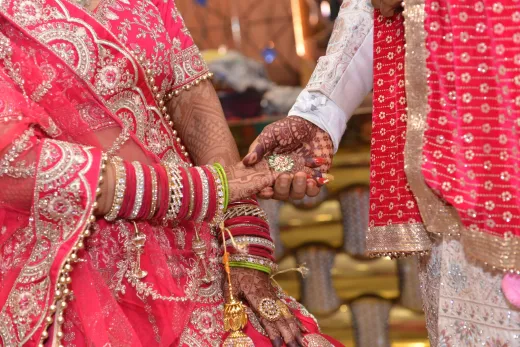
The dress is equally distinctive. Brides traditionally wear a red or maroon Benarasi saree, rich with gold work, crowned by the topor and mukut, conical headpieces made of pith, and adorned with gold jewellery and intricate designs. The groom often wears a dhoti and kurta or a sherwani, with his own topor. Alongside the henna and finery familiar from wider South Asian celebrations, this palette of red, gold and white gives the Bengali wedding its signature look. For a broader tour of bridal attire across cultures, our guide to bridal wear places these choices in a wider context.
Bengali marriage in the modern world
Like weddings everywhere, Bengali marriages are evolving. Many families now blend cherished rituals with contemporary choices: shorter celebrations to suit busy lives, destination venues, a lighter reception outfit alongside the traditional saree, and modern matchmaking to bring couples together in the first place. What tends to endure is the emotional core, the involvement of family, the turmeric ceremony, the feast, and the sense of two families joining rather than only two individuals.
Bengali marriages arise through both arranged introductions and love matches, and increasingly through a combination of the two, where families and online platforms help couples meet and the couples themselves decide. If you are curious about how introductions traditionally work, our guide to arranged marriage explains the modern, consent-led form. Thoughtful matchmaking services such as matrimony360 aim to support that same blend of family involvement and personal choice, letting couples find each other while honouring the traditions they hold dear.
The bottom line
A Bengali marriage is a multi-day celebration of colour, ritual, family and food, shaped by the shared culture of Bengal and expressed differently in its Hindu and Muslim forms. From the turmeric of the gaye holud to the sindoor of a Hindu ceremony or the contract of a Muslim Nikah, and from the red Benarasi saree to the famous wedding feast, it is a tradition rich with meaning. Whether you are planning one, attending one or simply learning, approaching it as a sequence of joyful, meaningful days is the way to appreciate it fully.
Frequently asked questions
How many days does a Bengali wedding last?
A Bengali wedding is typically a multi-day celebration rather than a single event. The exact number varies by family and region, but there are usually distinct pre-wedding days, such as the gaye holud, the main wedding day itself, and post-wedding events like the reception hosted by the groom's family. Understanding it as a sequence of days, each with its own mood, is the best way to make sense of the whole.
What is the gaye holud ceremony?
The gaye holud is the turmeric ceremony, one of the most joyful and colourful moments of a Bengali wedding. A paste of turmeric is applied to the bride and groom by family and friends to bless and brighten them before the wedding, usually amid sweets, music and dancing. It is celebrated in both Hindu and Muslim Bengali weddings and is one of the celebration's signature events.
How do Hindu and Muslim Bengali weddings differ?
They share much of the same Bengali cultural texture, including the gaye holud, the feasting and the days-long structure, but their core religious rites differ. A Hindu Bengali wedding centres on rituals such as the exchange of garlands, circling the sacred fire and the application of sindoor. A Muslim Bengali wedding centres on the Nikah, the Islamic marriage contract, with witnesses and the mahr. The surrounding customs of colour, food and family are broadly shared.
What does a Bengali bride traditionally wear?
A Bengali bride traditionally wears a red or maroon Benarasi saree rich with gold work, along with the topor and mukut, conical headpieces made of pith, and gold jewellery. Intricate designs and, in many families, henna complete the look. The overall palette of red, gold and white gives the Bengali bridal aesthetic its distinctive and recognisable character.
Why is fish so important at a Bengali wedding?
Food is central to Bengali culture, and fish holds a place of special honour, with the prized hilsa in particular associated with celebration and abundance. A Bengali wedding feast is famous for its scale and its sequence of dishes, and a family's hospitality is often judged by how well guests are fed. Fish therefore features prominently as both a delicacy and a symbol of a generous celebration.