Mens Wedding Bands: The Complete Guide
The how-to-buy guide: sizing his finger, budgeting for what really drives cost, timing the order around engraving and resizing, and where to buy with honest trade-offs.
Choosing a metal is the fun part of buying a wedding band. Actually buying the thing, getting the size right, timing it so it arrives engraved and resized before the wedding, and not overpaying, is where grooms come unstuck. This is the practical buying guide for the whole cluster. It walks through how to measure his finger properly (and why the number keeps moving), how to set a budget that reflects what really drives cost, when to place the order so nothing runs late, where to buy with the honest trade-offs of each option, how to coordinate with a partner's ring, and how to protect the band once it is on. If you already know which metal you want, start here. If you do not, read our overview of male wedding bands first, then come back for the buying process.
The short version
- Size at the right moment. Fingers swell in heat and shrink in cold, so a mid-day, room-temperature reading is the honest one.
- Knuckle rules the fit. If the knuckle is larger than the base, the band has to clear the knuckle and will spin.
- Cost is metal plus width plus work, not a brand name. Wider bands and precious metals carry more material.
- Order six to eight weeks out. Engraving, resizing and custom work all eat the calendar.
- Insure it the day it is yours. A band is small, easy to lose, and rarely covered by default.
Get his ring size right first
Everything downstream depends on this number, and it is the one most couples rush. A wedding band sits on the finger for decades, so a size that is a fraction out becomes a daily annoyance: too tight and it traps the knuckle and reddens the skin, too loose and it spins, thins on the underside and eventually vanishes down a drain. The good news is that measuring properly costs nothing but a little care about when and how you do it.
Ring size is simply a measure of the inside of the band. As the Wikipedia entry on ring size explains, size is defined by the inner circumference or diameter of the ring, and different countries use different scales for the same physical opening: North America uses a numbered scale in quarter steps, the UK, Ireland and Australia use letters, continental Europe often uses the circumference in millimetres, and India, Japan and China use their own numeric systems. That matters the moment you buy across borders or online: always confirm which country's scale a listing uses, because a "size 9" is not the same ring everywhere.
Why the number keeps moving
A finger is not a fixed object. It changes across the day and the year, and a band bought at one extreme will disappoint at the other. Three forces do most of the moving, and knowing them lets you take a reading you can trust.
Temperature
Heat swells fingers, cold shrinks them. Never size in a cold room, first thing in the morning, or straight after a cold walk.
Time of day
Fingers are smallest in the morning and largest late in the day. Measure mid to late afternoon at room temperature for a true middle reading.
Weight and health
Weight change, exercise, salt, alcohol and some medications all shift finger size. Avoid sizing after a heavy workout or a salty meal.
The knuckle
The band must pass the knuckle, then settle at the base. If the knuckle is much larger, size to clear it and expect some spin, or choose an adjustable inner fit.
Width adds size
A wide band feels tighter than a narrow one at the same measurement. For an 8mm band, size up by a quarter to a half.
Winter versus summer
If the wedding is in high summer or deep winter, favour that season's reading so the ring fits on the day it matters.
The most reliable method is to have a jeweller measure with a set of metal sizing rings, on a normal afternoon, on the exact finger the band will live on. Do it two or three times on different days and take the consistent reading, not the outlier. Printable paper sizers and plastic tools work in a pinch, but they flex and read small, so treat any at-home number as a starting point to confirm in person. Whatever you do, do not size a surprise ring by borrowing a ring he never wears on that hand, because it will almost certainly be a different size.
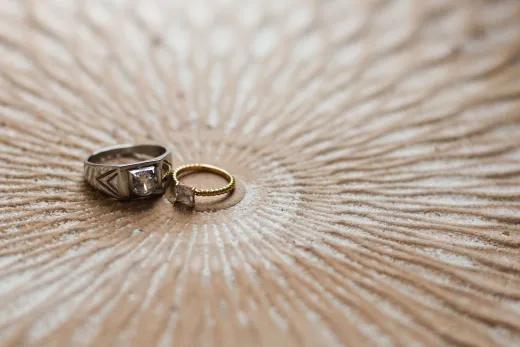
A band is a compromise between two measurements: wide enough to pass the knuckle, snug enough to sit at the base. The accent ring shows where it finally rests.
Set a budget around what actually drives cost
There is no correct amount to spend on a wedding band, and the old rules of thumb about months of salary are marketing, not arithmetic. A useful budget starts from what genuinely moves the price, so you can spend where it counts and save where it does not. Three levers do most of the work.
Metal is the biggest. Precious metals cost far more than contemporary ones, and among precious metals platinum sits above gold because it is denser and rarer. Gold purity is measured in karats, and as the Wikipedia article on jewellery notes, softer high-purity gold is alloyed for durability, so an 18 carat band carries more pure gold, and more cost, than a 9 or 14 carat one. Platinum jewellery, the same source records, is typically 90 to 95 percent pure, which is part of why it is priced at the top. If gold is your direction, our guide to men's gold wedding bands breaks down carats and colours in detail.
Width and mass come next. A band is sold, in effect, by the amount of metal in it. An 8mm band uses far more material than a 4mm one in the same metal, so it costs more and weighs more. Work is the third lever: engraving, patterned or hammered finishes, inlays, stones and fully bespoke commissions all add labour and therefore price. A plain, narrow band in a contemporary metal is the floor; a wide, custom, stone-set precious-metal ring is the ceiling, and almost every choice you make slides you along that line.
Where to save without regret: a slightly narrower band and a simple polished finish cut the price meaningfully while changing the look very little. Where not to skimp: buy the metal you actually want to wear for life, because that is the one thing you cannot change later without buying a whole new ring. It is easier to talk yourself down a width than to learn to love a metal you settled for.
Buy at the right time
A wedding band is not a same-week purchase. Between choosing, sizing, engraving and any resizing, a ring can spend weeks in a workshop before it is ready to wear, and a custom piece longer still. The single most common band mishap is leaving it late and then paying rush fees, or worse, walking down the aisle with a ring that does not fit because there was no time to adjust it. Work backwards from the wedding date with this timeline.
| When | Do this | Why the timing matters |
|---|---|---|
| 3 to 4 months out | Decide the metal and style; get his finger measured | Leaves room to change your mind before anything is ordered |
| 8 to 10 weeks out | Order a custom or bespoke band | Bespoke work is slow; this is the deadline for a made-to-order ring |
| 6 to 8 weeks out | Buy an in-stock band and book engraving | Engraving takes days to weeks and the ring is unavailable while it is done |
| 4 to 6 weeks out | Confirm the fit; request any resizing | Precious metals resize in days; leave a buffer for a second adjustment |
| 2 to 3 weeks out | Final try-on; arrange insurance | Catch a fit problem while there is still time to fix it |
| 1 week out | Collect, check the engraving, store safely | Hand it to whoever is holding the rings on the day |
Two timing traps deserve a flag. First, engraving locks the ring in the workshop and cannot be rushed without risking the finish, so decide on the words early. Second, some contemporary metals such as tungsten and ceramic cannot be resized at all, which means the fit has to be right the first time and the only fix for a bad size is a replacement, on a fresh lead time. If there is any doubt about his size, that fact alone is a strong argument for a resizable precious metal.
Where to buy, and the honest trade-offs
The same band can be bought three very different ways, and each suits a different couple. None is simply best; they trade price against service, speed and the ability to try before you buy.
High-street jeweller
You try rings on, get expert sizing, and have resizing, engraving, repairs and warranty under one roof. You pay more for that service and hands-on trust.
Online retailer
Wider choice and lower prices, often with home try-on kits. The catch is sizing at a distance and slower, postal fixes if anything is wrong.
Custom or bespoke maker
Exactly the ring you imagine, made to your finger. It is the most personal and usually the priciest route, and it needs the longest lead time.
A practical middle path many couples take is to size and try styles in person at a shop, then decide whether the online price on a comparable band is worth giving up the in-store service. If you buy online, choose a seller that offers a free home sizing kit, a clear return window and a resizing policy in writing, and confirm which country's size scale the listing uses. For a first wedding band, especially if his size is uncertain or the metal needs to be resizable, the reassurance of a good local jeweller often earns its premium. For a plain contemporary-metal band bought as a spare or a work ring, online is hard to beat on price.
Coordinate with the partner's ring
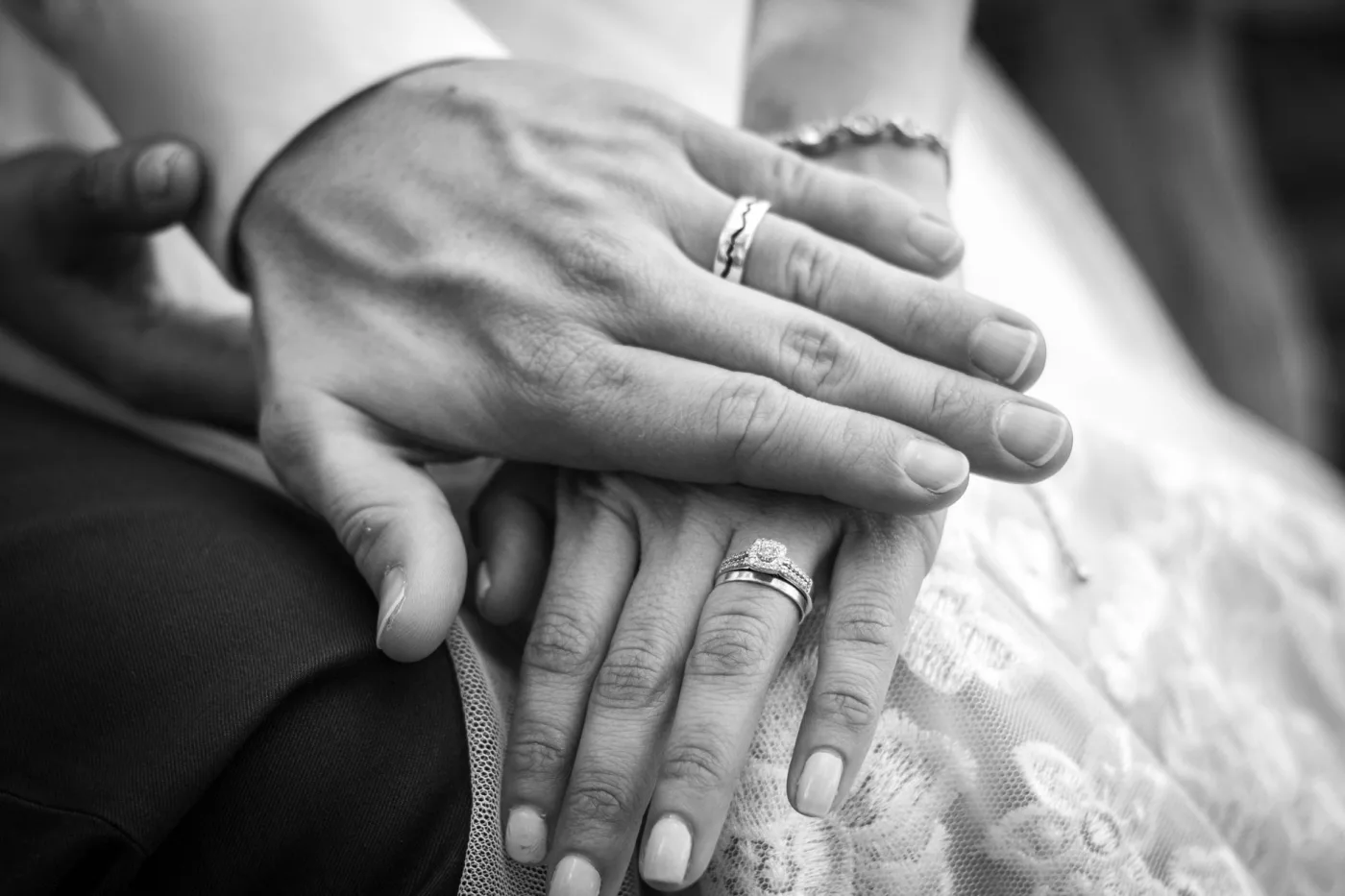
A men's band rarely lives alone; it sits next to a partner's ring for a lifetime, so it is worth thinking about the pair together. Matching means the same metal, finish and often the same maker, for a deliberately unified look. Coordinating is looser: complementary rather than identical, perhaps a shared metal in different widths and finishes, so each ring suits the hand it is on while still reading as a set. There is no rule that they must match at all, and plenty of couples happily wear quite different bands.
Two practical notes. Metals wear against each other over years, so if one partner stacks a wedding band against an engagement ring, matching or compatible metals age more gracefully than a hard metal grinding on a soft one. And remember that men's bands wearing at all is a fairly modern convention: the Wikipedia entry on wedding rings records that in the United States and Canada rings were once worn only by wives and became customary for both spouses during the twentieth century, and that many cultures wear the band on the right hand rather than the left. There is no single correct tradition to obey, so choose the pairing that suits the two of you. For the bigger picture of choosing both rings, see our guide to wedding bands.
Warranties, insurance and aftercare
The purchase is not finished when the ring is on the finger. A band is small, valuable and easy to lose, and most home contents policies do not cover it by default or cap single items well below its value. Sort protection the day the ring becomes yours, not after the honeymoon.
Ask the seller what the warranty covers and for how long: reputable jewellers often include a period of free resizing, a manufacturing-fault guarantee and periodic cleaning or re-plating for white gold. Keep the receipt and any certificate, and consider an independent valuation for insurance. Then either add the band to a home policy as a specified item or take out standalone jewellery cover, checking that it includes loss, not only theft and damage, since loss is how bands actually disappear. Finally, build the maintenance habit the metal needs: an occasional professional polish and, for white gold, re-plating every couple of years, plus the simple discipline of taking the ring off before heavy lifting, sport and harsh chemicals, and having one fixed place to put it.
Pre-purchase checklist: confirmed size taken at room temperature on the right finger and the right hand; the metal decided and its resizing reality understood; width and finish chosen against budget; engraving wording finalised early; a realistic order date set against the wedding; the seller's return, resizing and warranty terms in writing; and insurance arranged for the day you collect it. Tick all seven and almost nothing can go wrong.
Putting it all together
A men's wedding band is a small purchase that rewards a little process. Measure his finger properly and at the right moment, budget around metal, width and work rather than a headline number, order with weeks to spare so engraving and resizing have room, pick the buying channel whose trade-offs suit you, think about how the ring pairs with a partner's, and protect it the moment it is yours. Do those things and the band that arrives will fit, look right and be covered, which is the whole job. When you are ready to choose the metal itself, our overview of male wedding bands weighs every option, or go straight to the detail on men's gold wedding bands if gold is already the plan.
Frequently asked questions
How do I measure his ring size accurately at home?
Measure the exact finger the band will sit on, in the mid to late afternoon at room temperature, when fingers are at a true middle size rather than swollen from heat or shrunk from cold. Take the reading two or three times on different days and use the consistent number, not an outlier. Paper and plastic sizers work as a starting point but read small because they flex, so confirm with a jeweller's metal sizing rings before you buy. Do not size a surprise ring from a ring he wears on a different finger, since sizes vary from finger to finger.
How far in advance should I buy a men's wedding band?
Allow six to eight weeks for an in-stock band that needs engraving or resizing, and eight to ten weeks or more for a custom or bespoke ring. Engraving takes days to weeks and the ring is unavailable while it is done, and resizing needs a buffer in case a second adjustment is required. Leaving it late means rush fees or, in the worst case, a ring that does not fit on the day. Work backwards from the wedding date and order with weeks to spare.
What actually drives the price of a men's wedding band?
Three things: the metal, the amount of it, and the work done to it. Precious metals such as gold and platinum cost far more than contemporary metals, and higher-karat gold costs more than lower. A wider band uses more material than a narrow one in the same metal, so it costs and weighs more. Engraving, patterned finishes, inlays, stones and bespoke commissions all add labour. Brand name aside, a plain narrow contemporary band is the cheapest option and a wide custom precious-metal ring the priciest.
Is it better to buy a wedding band online or from a jeweller?
Both work, with different trade-offs. A high-street jeweller lets you try rings on, sizes his finger expertly, and keeps resizing, engraving and warranty under one roof, which you pay a premium for. Online retailers offer more choice and lower prices, often with home try-on kits, but sizing at a distance is riskier and fixes are slower and postal. A common approach is to size and try styles in person, then decide whether the online saving is worth losing the in-store service. For an uncertain size or a metal that must be resizable, a good local jeweller usually earns its cost.
Do men's and women's wedding bands need to match?
No. Some couples choose matching bands in the same metal and finish for a unified look, others coordinate with complementary metals and widths, and many happily wear quite different rings. The one practical point is that metals wear against each other over years, so if bands or a stacked engagement ring sit together, matching or compatible metals age more gracefully than a hard metal against a soft one. Beyond that, there is no rule, so choose the pairing that suits you both.
Should I insure a wedding band, and how?
Yes, and from the day it is yours. Bands are small, valuable and easy to lose, and most home contents policies either exclude them or cap single items below their value. Keep the receipt and any valuation, then either add the band to a home policy as a specified item or take out standalone jewellery cover. Check that the policy includes loss, not only theft and damage, because loss is how wedding bands most often disappear.