Muslim Wedding Invitation: The Complete Guide
The Bismillah, the nikah and walima, and warm family wording: how Muslim wedding invitations work across cultures.
A Muslim wedding invitation carries its faith openly, usually from the very first line. It commonly opens with an invocation of God, names both families with respect, and invites guests to a nikah and often a walima, the two events at the heart of an Islamic marriage. Beyond those shared conventions, Muslim weddings span an enormous cultural range, from South Asia to the Arab world to West Africa and beyond, so the invitations vary just as widely in language and design. This guide explains the elements a Muslim wedding invitation typically shares, the events it announces, how it is worded, and the etiquette that keeps it warm and correct.
The short version
- Faith opens the card. Most begin with the Bismillah or a short Quranic line invoking God's blessing.
- Two core events. The nikah is the marriage contract; the walima is the celebratory feast that follows.
- Both families are honoured. The invitation names elders and families, reflecting a union of households.
- Culture shapes the rest. Language, colour and extra events differ widely between Muslim communities.
What sets a Muslim wedding invitation apart
The defining feature is that the invitation is explicitly rooted in faith. Where a secular card jumps straight to names and dates, a Muslim invitation usually begins by invoking God and often frames the marriage as an act of worship and a following of the Prophet's example. As Wikipedia's overview of marriage in Islam notes, marriage is regarded as a strongly recommended and virtuous act, a legal contract between two parties, and the invitation reflects that seriousness and joy at once.
The second thing to understand is diversity. There is no single Muslim wedding invitation, because Islam spans dozens of cultures. A card from a Pakistani family, an Egyptian family, a Turkish family and a Nigerian family will share the same faith-led spirit but differ in language, motifs, colours and the exact events listed. The conventions below are the common thread; your own community's traditions fill in the rest.
The Bismillah and Quranic openings
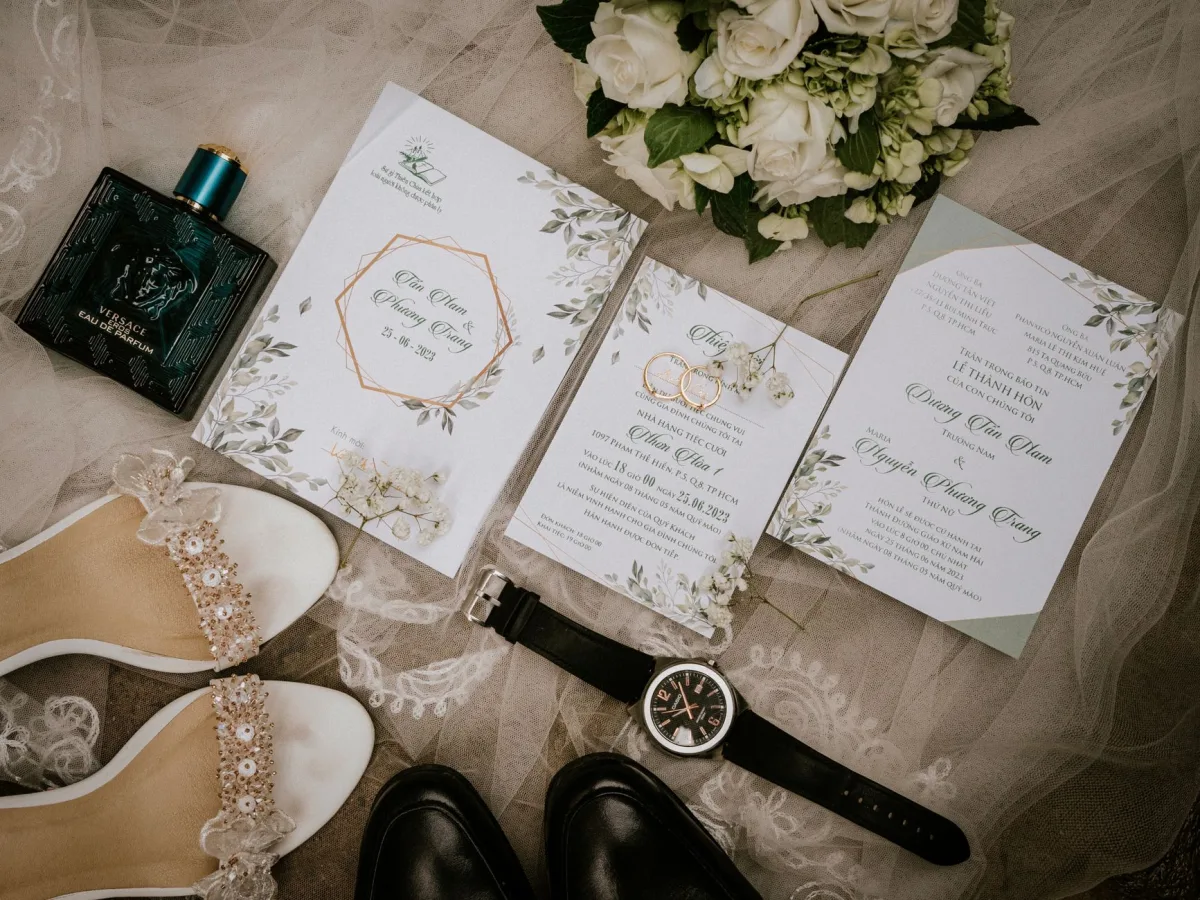
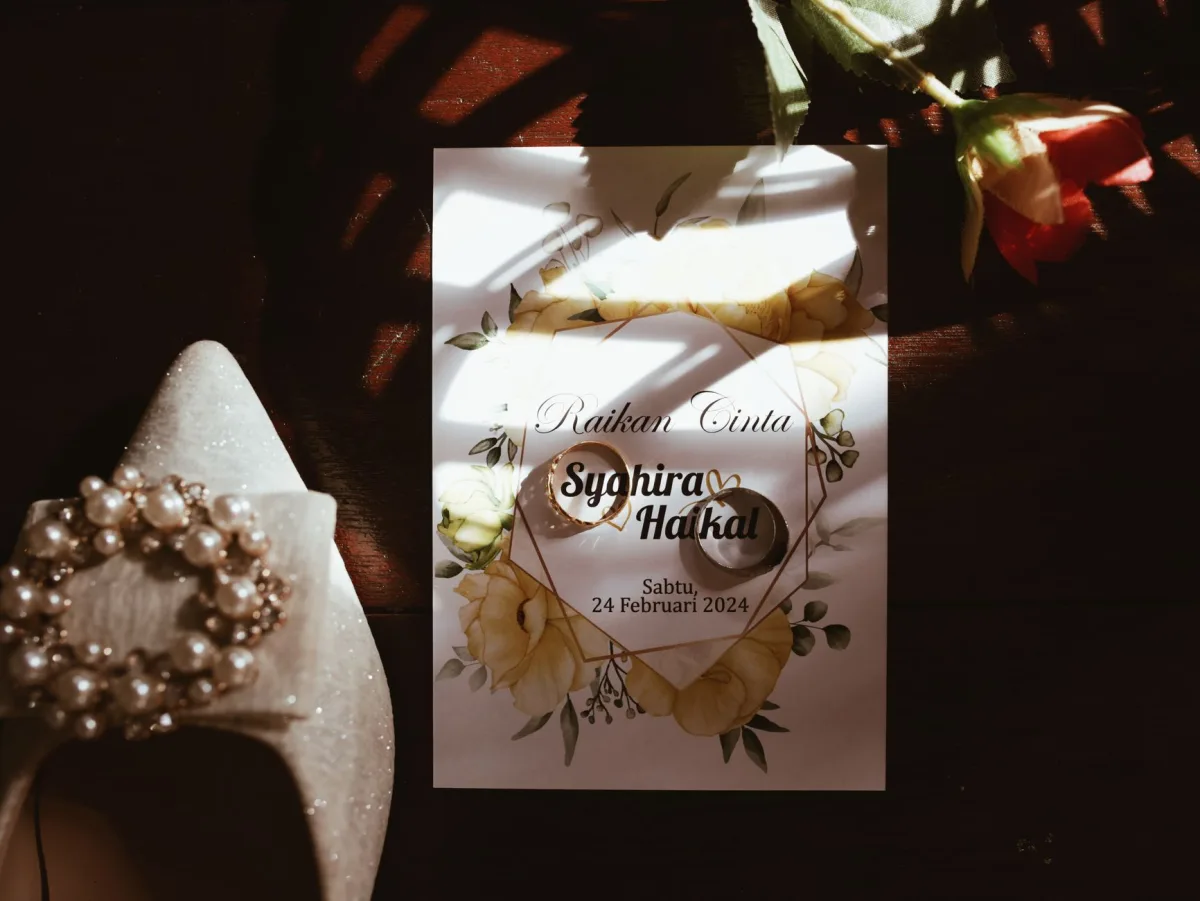
Most Muslim wedding invitations open with the Basmala, the phrase "Bismillah ir-Rahman ir-Rahim," meaning "In the name of God, the Most Gracious, the Most Merciful." As Wikipedia describes, this is the phrase recited before undertakings across Muslim life, and beginning the invitation with it dedicates the marriage to God from the outset. Many cards follow it with a short Quranic verse about marriage, most often the well-loved passage describing spouses as a source of tranquillity and affection placed between them, which sets a tone of mercy and love.
This opening is not decoration; it is the heart of the card's identity. It is usually given pride of place at the top, often in elegant Arabic calligraphy, and it signals immediately that this is a wedding grounded in faith. Because the wording of these verses is sacred, families take care to render them accurately, and it is worth checking any Arabic or transliteration with someone knowledgeable before printing.
The events a Muslim invitation announces
A Muslim wedding invitation typically announces two central events and, depending on culture, several surrounding celebrations. Knowing what each one is helps you list them clearly.
The nikah
The Islamic marriage contract and the religious heart of the wedding, in which consent is given and the marriage is solemnised, often at a mosque, home or hall.
The walima
The marriage feast hosted after the union, a sunnah act through which the couple's families celebrate publicly and share food with the community.
The mehndi or henna
In South Asian and many other cultures, a festive pre-wedding night of henna, music and food, often given its own card or panel.
Engagement and cultural events
Some communities add an engagement, a mangni, or other regional celebrations, each with its own timing and often a lighter design.
The walima deserves a special word, because Wikipedia describes it as the marriage banquet, a sunnah traditionally held after the marriage is consummated, at which the wider community is welcomed. In practice many families combine or sequence the nikah and walima across one or two days, and the invitation should make the order and timing of both unmistakably clear so guests know which events they are invited to.
Wording and language
After the invocation, the wording usually names the hosts, most often the parents or elders of both families, and extends the invitation in their voice, before naming the couple. This mirrors the wider convention across many South Asian and Middle Eastern invitations, where a wedding is understood as a joining of families rather than of two individuals alone. The language is warm and respectful, inviting guests to grace the occasion with their presence and to bless the couple.
Bilingual cards are extremely common. A card may pair English with Arabic, Urdu, Turkish, Bengali or another language, with the Quranic opening in Arabic and the practical details in the family's everyday tongue. If you want the full toolkit of host lines, formal phrasing and how to handle events on one card, our general guide to wedding invitation wording lays out the mechanics, and because many Muslim weddings in South Asia share conventions with the wider region, our guide to Indian wedding invitations is a useful companion for multi-event suites.
Design, colour and calligraphy
Islamic design has a rich visual tradition, and Muslim wedding invitations draw on it freely. Because figurative imagery is generally avoided in a religious context, the decoration leans on geometry, arabesque patterns, floral motifs and, above all, calligraphy. Arabic calligraphy is itself a revered art form, and a beautifully rendered Bismillah or verse is often the visual centrepiece of the card.
Colour choices vary by culture rather than by rule. Green carries a special resonance in Islam and appears often, alongside gold, deep blues, maroon and elegant neutrals; South Asian Muslim cards may lean warm and ornate, while some Arab and Turkish designs favour cleaner, more minimal palettes. Metallic foil, embossing and laser-cut geometric panels are popular finishes for premium suites. The guiding principle is that the design should feel dignified and celebratory at once, in keeping with an event that is both an act of faith and a joyful union.
Digital Muslim wedding invitations
Digital invitations have become widely accepted, and they suit Muslim weddings well, especially where families are spread across countries. A digital card or wedding website can carry the invocation, the nikah and walima timings, maps and dress notes in one place, update instantly, and collect responses without printed reply cards. Animated e-invites, shared over messaging apps, let large extended families be reached quickly and respectfully.
A hybrid approach is common and thoughtful: an elegant printed card for elders and close relatives, for whom the physical invitation is a mark of respect, and a digital version for the wider circle. Whichever route you take, the same care applies to the sacred text, since a Quranic verse should be rendered accurately whether it is printed or animated. The medium can change; the reverence for the words should not.
Timeline and etiquette
Because many Muslim wedding suites are custom-designed and may involve calligraphy, foil or multiple event cards, allow generous lead time. Ordering roughly two to three months ahead is sensible, with finished invitations sent to guests around five to seven weeks before the wedding, and close family often invited earlier and more personally. If the nikah and walima fall on different days, or the guest lists differ, spell that out plainly so no one arrives at the wrong event.
Etiquette here is warm but attentive to a few things. Render the sacred text and any Arabic accurately, spell elders' names and titles with care since their inclusion honours them, and keep the events and their timings unambiguous. Done well, a Muslim wedding invitation achieves something quietly beautiful: it dedicates the marriage to God, honours both families, and welcomes the community, all in a single card. When the wedding is the celebration of a match made thoughtfully from the start, that beginning is exactly where Matrimony360 helps, and our guide to the rishta process speaks to the family-centred search that so often precedes the card.
Frequently asked questions
How do you start a Muslim wedding invitation?
Most Muslim wedding invitations open with the Bismillah, "In the name of God, the Most Gracious, the Most Merciful," which dedicates the marriage to God from the first line. Many cards then add a short Quranic verse about marriage, often the passage describing spouses as a source of tranquillity and affection. This faith-led opening, frequently rendered in Arabic calligraphy, is usually given pride of place at the top of the card before the families and events are named.
What is the difference between a nikah and a walima invitation?
The nikah is the Islamic marriage contract and the religious heart of the wedding, in which consent is given and the marriage is solemnised. The walima is the marriage feast held afterward, a sunnah through which the families celebrate publicly and welcome the wider community. A single invitation often lists both, sometimes on different days or with different guest lists, so the card should make the order, timing and location of each event unmistakably clear.
Can a Muslim wedding invitation include Quranic verses?
Yes, and it is very common. Many cards open with the Bismillah and a short verse about marriage, often in Arabic calligraphy, as a way of grounding the celebration in faith. Because the wording of these verses is sacred, families take care to render the Arabic and any transliteration accurately, ideally checking it with someone knowledgeable before printing. The verse is usually treated as the visual and spiritual centrepiece of the invitation.
What colours are used for Muslim wedding invitations?
There is no single rule, and colour choices follow culture more than religion. Green carries a special resonance in Islam and appears often, alongside gold, deep blues, maroon and elegant neutrals. South Asian Muslim cards tend to be warm and ornate, while some Arab and Turkish designs favour cleaner, more minimal palettes. Because figurative imagery is generally avoided, the decoration leans on geometry, arabesque patterns and calligraphy rather than pictures.
When should Muslim wedding invitations be sent?
Because the suites are often custom-designed and may involve calligraphy or multiple event cards, order them about two to three months ahead. Send the finished invitations to guests roughly five to seven weeks before the wedding, and invite close family and elders earlier, often more personally. If the nikah and walima are on different days or have different guest lists, state that clearly so every guest knows exactly which events they are welcome to attend.