Wedding Invitations: The Complete Guide
Everything a wedding invitation does at once: it sets the tone, encodes the etiquette, and collects the one number the whole day depends on, your final headcount.
A wedding invitation is doing more work than it looks. It is the first thing your guests hold, so it sets the tone of the day before anyone reads a word. It is also a small machine: it tells people when and where to be, how to dress, whether they can bring someone, and it collects the single number that everything downstream depends on, your final headcount. Get the wording, the timing and the suite right and the rest of your stationery runs itself. This is the complete guide to wedding invitations, from what belongs in the suite to how to word the tricky parts, when to send, what it costs, and how to choose between paper and digital.
The short version
- A suite is more than one card. Save-the-date, main invite, RSVP and a details card each do a different job.
- Send the main invite 6 to 8 weeks out, and give more lead time for destination or out-of-town guests.
- Wording encodes etiquette: who hosts, how formal the day is, the dress code, and who is and is not invited.
- Budget 2 to 3 percent of the wedding for stationery, and know that printing method drives most of the price.
What a wedding invitation suite actually includes
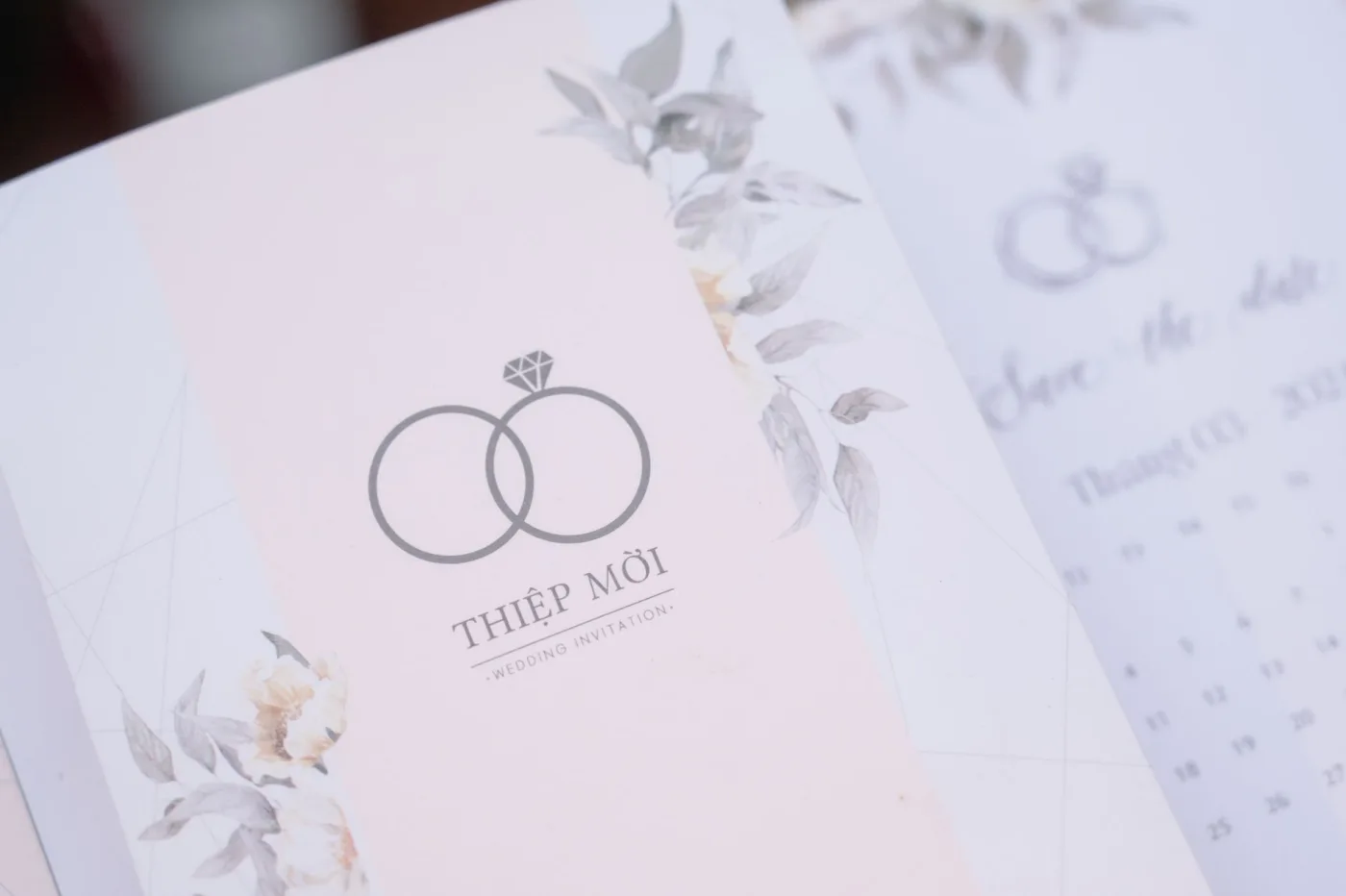
People say invitation when they usually mean the suite: the coordinated set of cards that arrives together and, taken as a whole, answers every practical question a guest has. A modern suite typically pairs the main invitation with an RSVP response card and, as Wikipedia notes for wedding invitation packages, extra information such as maps, directions, accommodation and childcare on a separate details card. You do not need every piece, but you should decide about each one on purpose rather than by default.
Save-the-date
Sent first, months ahead. A heads-up with the date and city so key people can hold the day. Not a full invitation.
Main invitation
The formal centrepiece: who is marrying whom, the hosts, the date, time and place of the ceremony.
RSVP card
The reply mechanism, with a response-by date. This is what turns a guest list into a real headcount.
Details card
Everything that is useful but not ceremonial: directions, parking, hotels, timings, dress code, a wedding website.
Reception card
Used when the reception is at a different place or time, or is a separate, smaller guest list.
Envelope and extras
Outer envelope, inner envelope, belly band, vellum wrap or wax seal. Optional flourishes that shape first impressions.
A useful way to think about it: the main invitation is ceremonial and the details card is practical. Resist the urge to crowd logistics onto the invitation itself. Keeping directions, parking and hotel blocks on their own card keeps the main card clean and formal, and it means you can reprint the busy, change-prone details without touching the piece guests are most likely to keep. If you are still mapping out where stationery sits among your other tasks, our wedding planning checklist shows exactly when in the timeline each piece needs to be ordered and sent.
Wording and etiquette: the part people overthink
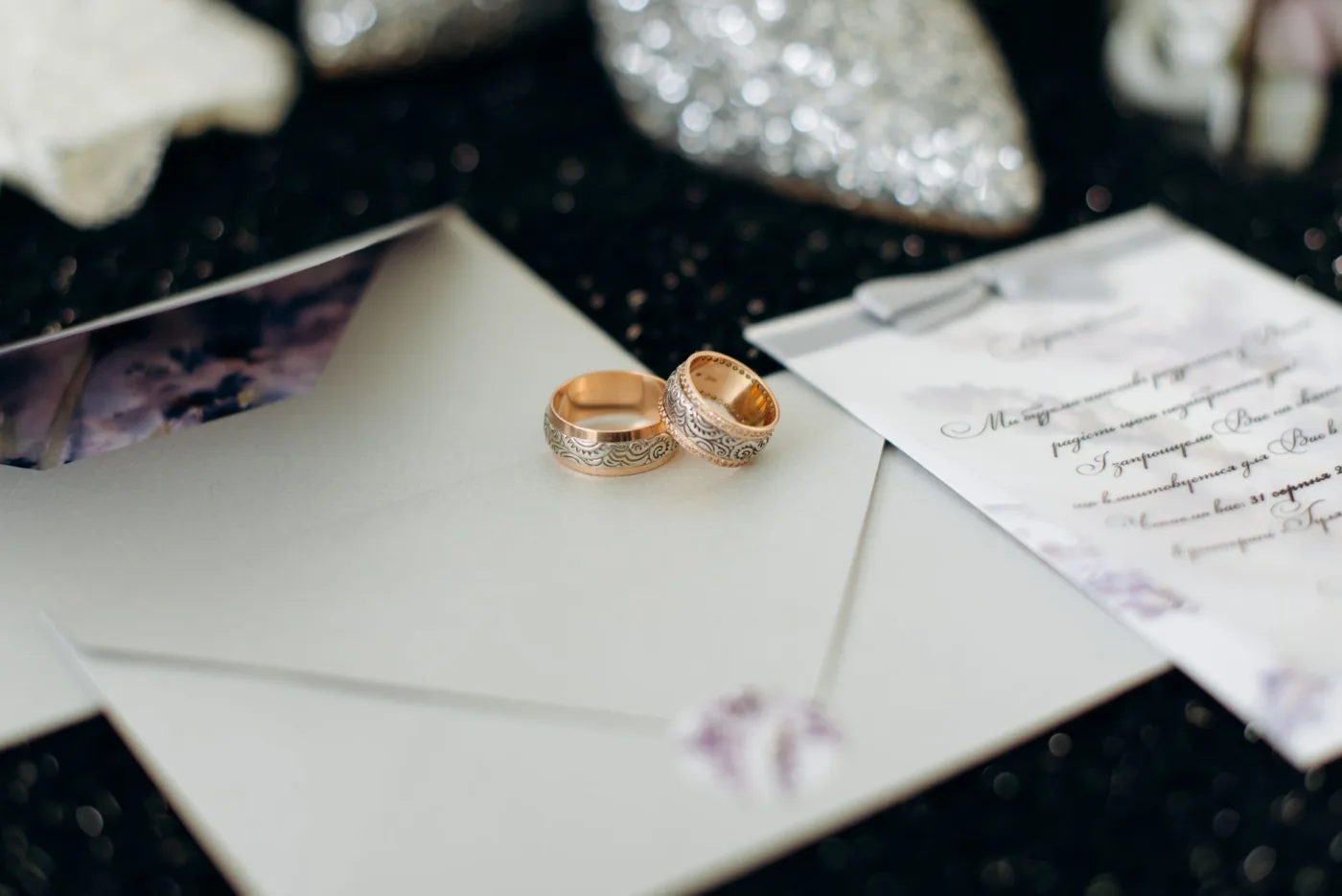
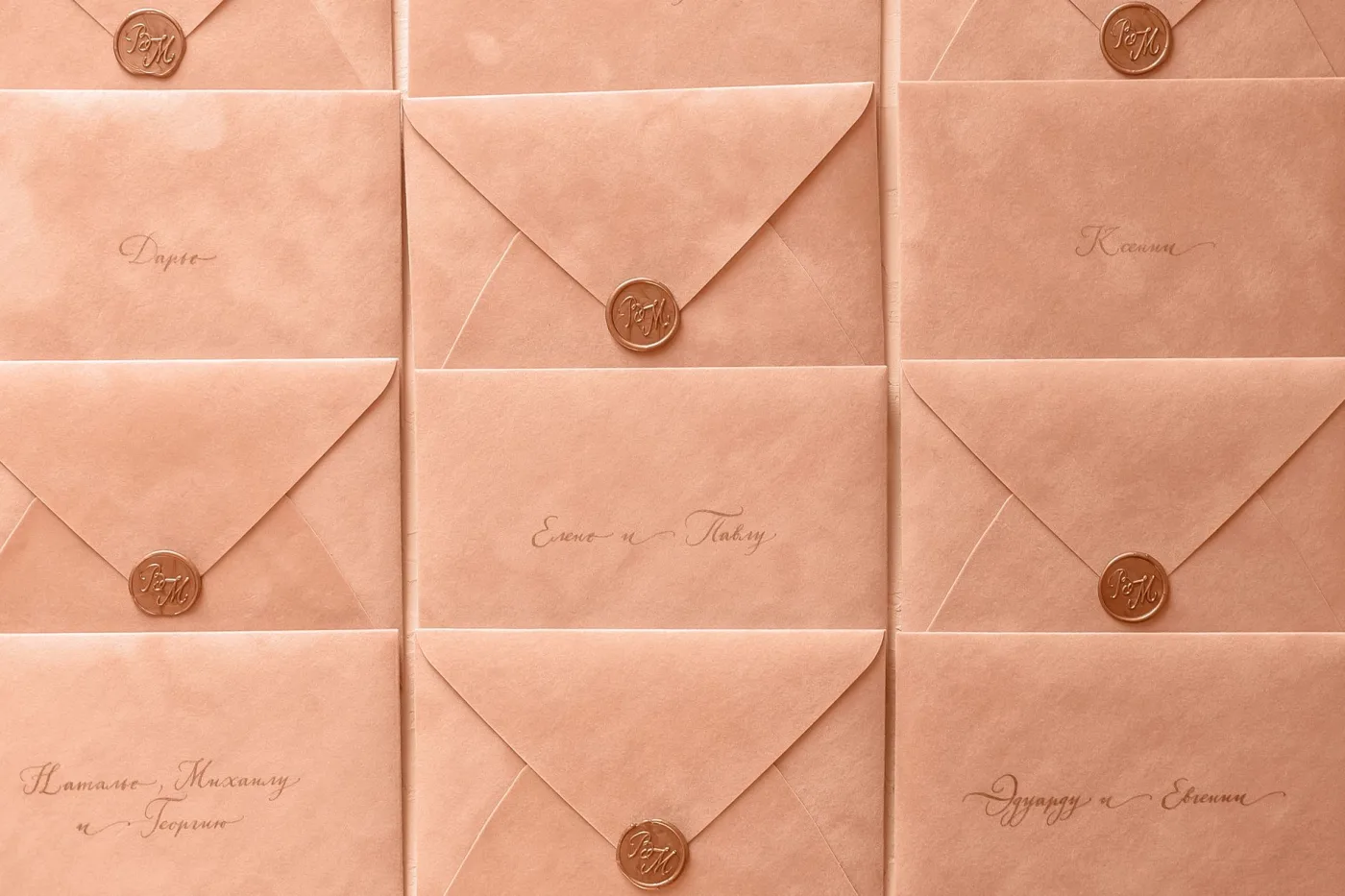
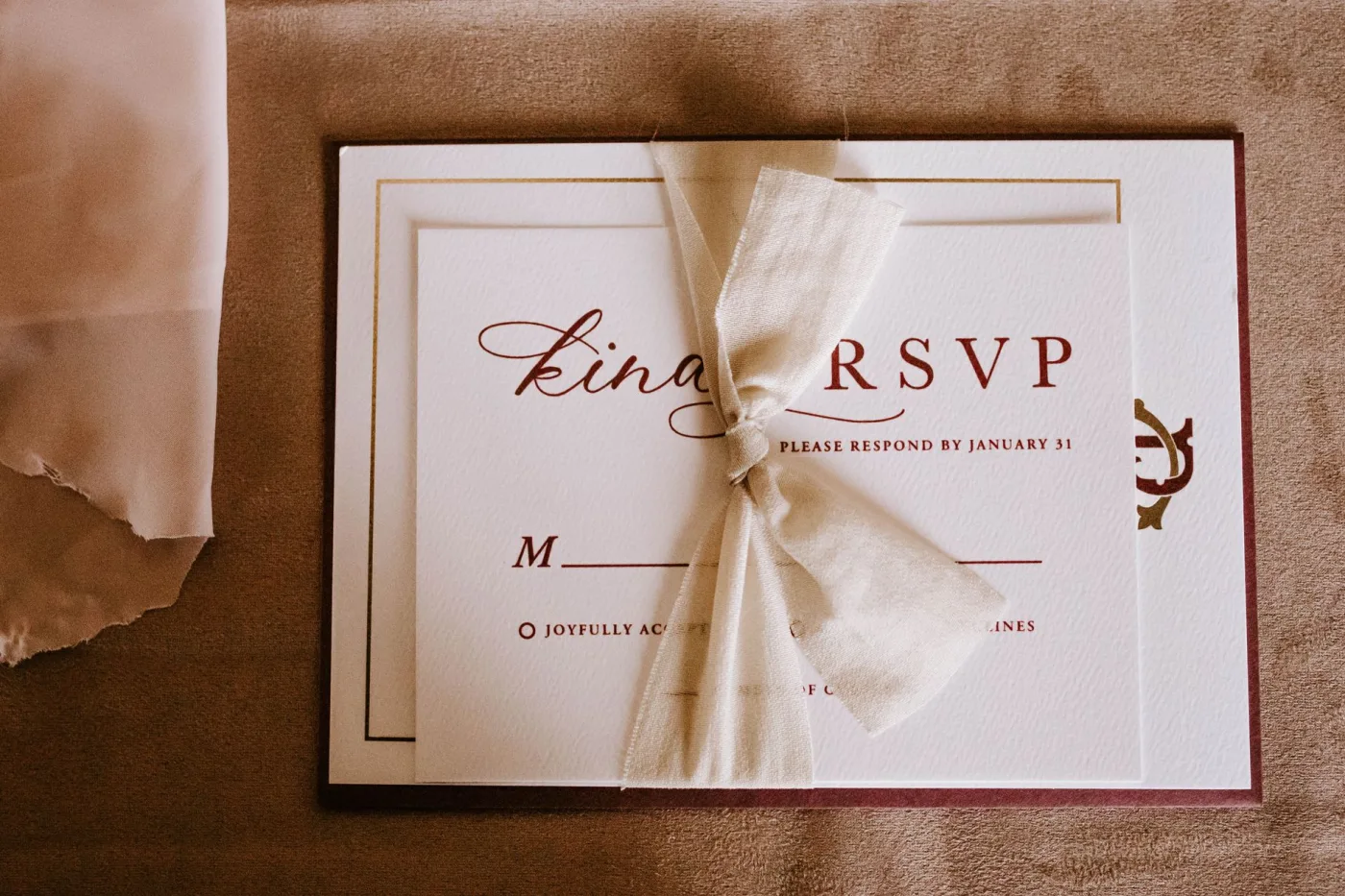
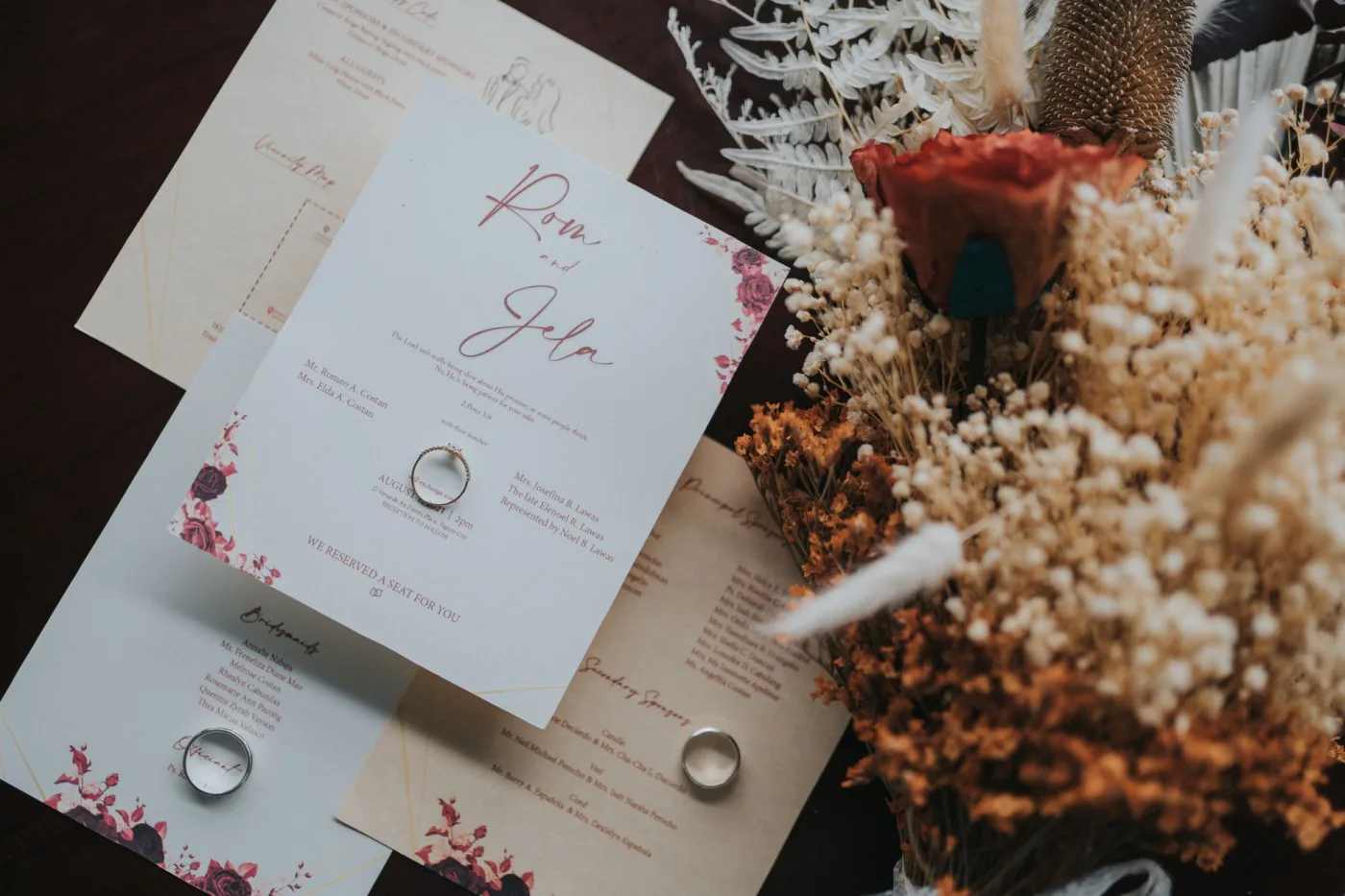
Invitation wording feels intimidating because it carries so many quiet signals at once. In practice it comes down to a handful of decisions. Settle these and the words almost write themselves.
Formal versus casual tone
Formal invitations traditionally use third-person language and spell things out in full: full names, no abbreviations, the year written out, and a request line such as "request the honour of your presence." Wikipedia notes that many invitations keep the British spelling "honour" even in the United States, a convention that traces back to Emily Post in the 1920s. The convention is that "the honour of your presence" signals a religious venue, while "the pleasure of your company" signals a secular one. A casual wedding can drop all of this and simply say "together with their families, Priya and Daniel invite you to celebrate their wedding." Neither is more correct. The tone of the card should match the tone of the day.
How to word the hosts
The host line names whoever is formally inviting the guests, which traditionally means whoever is paying, and it opens the invitation. Classic etiquette begins with the bride's parents, as in "Mr. and Mrs. John Smith request the honour of your presence at the marriage of their daughter." Modern weddings are funded in every combination, so the honest and increasingly common approach is to name both sets of parents, or to let the couple host themselves with a line like "together with their families." If parents are divorced or remarried, list them on separate lines. The rule under all the variations is simple: the host line reflects who is welcoming the guests, and there is no single arrangement you are obliged to use.
The etiquette that still matters: receiving an invitation does not obligate a guest to attend or to send a gift, as Wikipedia's overview of wedding invitations puts it plainly. The one genuine obligation an invitation creates is a prompt reply. Word your RSVP to make that reply as easy as possible, and you will spend far less of your final month chasing it.
Dress code, plus-ones and who is invited
Three things cause more confusion than anything else, and all three are solved with clear wording. Put the dress code on the details card, not the main invitation, and name it plainly: black tie, cocktail, semi-formal, or garden party. Vague phrases like "dress to impress" only generate questions. For plus-ones, the address on the envelope is the invitation: if a guest may bring someone, the envelope reads "and guest" or names the partner. Never leave it ambiguous, because an unclear envelope is how uninvited plus-ones appear at your final count. For an adults-only wedding, do not write "no children" on the invitation. Instead, address the envelope only to the named adults and, if needed, add a gentle line on the details card such as "we have chosen to keep our celebration adults only." Precision here is not cold. It protects both your budget and your guests from an awkward moment at the door.
When to send: the invitation timeline
Timing is where good intentions quietly go wrong. Send too late and you get last-minute regrets and a scramble for numbers. Send too early and the invitation gets buried and forgotten. The consensus, and the figure Wikipedia cites, is that invitations should go out roughly six to eight weeks before the wedding, with more lead time for out-of-town or destination guests. The save-the-date does the early heavy lifting so the invitation itself can land in that sweet spot.
The save-the-date holds the date early so the invitation can land in the six-to-eight-week window that actually gets replies.
| When | What to send or do | Why this timing |
|---|---|---|
| 8 to 12 months out | Send save-the-dates | Lets key guests book travel and hold the date, especially for destination weddings |
| 6 to 8 weeks out | Send the main invitation suite | Recent enough to stay top of mind, early enough to plan around |
| 3 months out (destination) | Send invitations early | Travelling guests need longer to arrange flights, leave and accommodation |
| 3 to 4 weeks out | RSVP deadline falls due | Gives you a buffer before the venue and caterer need final numbers |
| 1 to 2 weeks out | Chase stragglers, lock the count | A few replies always arrive late; call them, then confirm the headcount |
Set the RSVP deadline about three to four weeks before the wedding, never on the day the venue wants numbers. That gap is deliberate: it is the week you spend phoning the handful of guests who forget. Almost everyone forgets a wedding RSVP at least once, so build the chase into the plan rather than treating it as a failure.
Paper versus digital invitations
The paper-or-digital question is really a question about your guests and your day, not about which is objectively better. Both work. They simply suit different weddings.
Paper carries weight, literally and socially. It signals formality, it becomes a keepsake, and for older guests or a black-tie wedding it still reads as the proper way to be invited. It also costs more and takes longer, because you are paying for design, printing, envelopes and postage, and you need to allow time for proofs and reprints. Digital invitations are fast, cheap and easy to track, they collect RSVPs automatically, and they make it trivial to send reminders and updates if a detail changes. The trade-off is that they can feel less formal, and they lean on every guest having a phone and an email address they actually check.
Plenty of couples do both, and this is often the smartest answer. Send elegant paper invitations to the guests for whom it matters, and use a wedding website or a digital reply to actually collect responses and share the change-prone details. The invitation sets the tone; the website carries the logistics and can be updated at any time. Tools like The Knot's couple and registry finder show how a single wedding website can hold your details, registry and RSVP in one place while your printed suite stays clean and ceremonial.
RSVP is French, and it is a request, not a decoration. As Wikipedia's entry on RSVP explains, it stands for the French "repondez s'il vous plait," meaning "please respond." Whether your reply card is paper or a web form, spell out exactly what you want back: attendance, meal choice, and any dietary needs, each with its own clearly labelled line. The clearer the ask, the cleaner your count.
Budgeting: where the stationery money goes
Stationery is a small slice of the whole wedding, usually around two to three percent of the total budget, but within that slice the money is not spread evenly, and knowing where it concentrates lets you spend it well. The single biggest driver is not the paper. It is the printing method.
| Line item | Share of stationery spend | What moves it |
|---|---|---|
| Printing method | Highest | Digital is cheapest; letterpress, foil and engraving cost far more |
| Number of pieces | High | Every extra card in the suite multiplies across the whole guest list |
| Quantity | High | Priced per household, not per guest; order about 15 percent extra for errors |
| Paper and embellishment | Medium | Heavy stock, vellum, wax seals and ribbon add up quietly |
| Postage | Medium | Heavy or square envelopes cost more to post; weigh a full suite first |
| Design and calligraphy | Variable | Templates are near free; a custom designer or hand calligraphy is a real cost |
Two things surprise most couples. First, invitations are ordered per household, not per guest, so a couple who live together receive one suite: count envelopes, not heads, and always order a cushion of spares because reprinting a small top-up later costs far more per card than the original run. Second, postage is a real line item. A heavy suite with multiple cards, or a non-standard square envelope, can cost noticeably more to mail, so weigh a finished, fully stuffed sample at the post office before you buy stamps for the whole list.
If you want to see how this fits the wider spend, our wedding planning checklist puts stationery next to venue, catering and the rest, so you can decide what to trade off without letting one category quietly creep.
Design and style choices
Design is where the invitation stops being a form and starts being a first impression. The goal is coherence: the invitation should look like a small preview of the wedding, not a card chosen in isolation. A few decisions carry most of the effect.
Typography
The biggest single lever of tone. Elegant serifs and script read formal; clean sans-serifs read modern and relaxed.
Colour palette
Pull two or three colours from your day. The suite is the first time guests see your wedding's palette.
Printing method
Digital, letterpress, foil or engraving. This decides both the texture and most of the cost.
Layout
Generous margins and clear hierarchy make a card feel considered. Crowding is the most common design mistake.
A practical order of operations helps. Choose the tone first, formal or relaxed, because that decision quietly makes most of the others for you. Then pick typography and palette to match, and only then choose the printing method your budget allows. Keep the wording hierarchy clean: the couple's names are the largest element, the date and place are clearly secondary, and everything else is smaller still. When in doubt, remove rather than add. The most elegant invitations are almost always the ones with the most empty space, not the most decoration.
Whatever style you choose, remember what the card is ultimately in service of. The invitation is the opening note of the whole wedding, and a beautiful, clear one sets an expectation the rest of the day gets to live up to. If you are still early in the journey and choosing the partner as thoughtfully as the party, that is exactly where Matrimony360 begins.
Frequently asked questions
When should I send wedding invitations?
Send the main invitation suite about six to eight weeks before the wedding, and allow more lead time, often around three months, for out-of-town or destination guests who need to arrange travel. Send save-the-dates far earlier, typically eight to twelve months out, so key people can hold the date. Set the RSVP deadline three to four weeks before the day, which leaves you a buffer to chase late replies before the venue and caterer need final numbers.
What is included in a wedding invitation suite?
A full suite usually includes the main invitation, an RSVP response card with a reply-by date, and a details card carrying directions, accommodation, timings and dress code. Many couples add a save-the-date sent earlier, and a separate reception card when the reception is at a different place, time, or has a different guest list. Envelopes and optional extras such as a belly band or wax seal complete the set. You do not need every piece, but decide about each one deliberately.
How do I word the hosts on a wedding invitation?
The host line names whoever is formally inviting the guests, traditionally whoever is paying. Classic etiquette opens with the bride's parents, but modern weddings are funded in every combination, so it is entirely acceptable to name both sets of parents, or to have the couple host themselves with a line like "together with their families." For divorced or remarried parents, list them on separate lines. There is no single correct arrangement; the host line simply reflects who is welcoming the guests.
Should I send paper or digital wedding invitations?
Both work, and the right choice depends on your guests and your day. Paper feels formal, becomes a keepsake, and suits traditional or black-tie weddings, but it costs more and takes longer. Digital invitations are fast, inexpensive, easy to track, and collect RSVPs automatically, though they can read as less formal. A common solution is to send paper invitations while using a wedding website or digital reply to actually gather responses and share change-prone details.
How much should I budget for wedding invitations?
Plan for roughly two to three percent of your total wedding budget for stationery. Within that, the printing method drives most of the cost: digital printing is cheapest, while letterpress, foil and engraving cost considerably more. The number of pieces in the suite, the quantity, heavy paper, embellishments and postage all add up too. Because invitations are ordered per household rather than per guest, count envelopes, not heads, and order about 15 percent extra to cover errors.
Do I have to include an RSVP card?
You need a way to collect replies, but it does not have to be a printed card. RSVP stands for the French "repondez s'il vous plait," or "please respond," and its only job is to gather your headcount. A printed reply card with a stamped return envelope is traditional and easy for every guest, while a wedding website or online form is cheaper, faster and tracks responses for you. Whichever you choose, spell out clearly what you need back: attendance, meal choice and any dietary requirements.