Wedding Stage Decoration: 25+ Ideas With Photos
More than 25 ideas built in four layers, backdrop, florals, lighting and seating, sorted by style and budget for your most photographed backdrop.
The stage is where every eye in the room lands, the frame behind the couple in almost every photograph, and the one backdrop your guests will stare at for hours. Get it right and the whole room lifts; get it wrong and no amount of catering rescues the mood. This guide gathers more than twenty five stage decoration ideas, sorted by style, element and budget, so you can build a backdrop that looks like you rather than like a rented default.
The short version
- The stage is your most photographed backdrop, so design it for the camera, not just the room.
- Build it in layers: backdrop, florals, lighting and a defined couple's seat.
- Scale the design to the venue. A backdrop that fills a small hall drowns in a large one.
- Lighting does the heavy lifting and is often the cheapest way to transform a plain stage.
Why the stage deserves its own plan
In a theatre the stage is the designated space where the action happens and every sightline is arranged around it. A wedding stage works the same way: it is the focal point the room is built around, whether it holds the ceremony itself or the couple's seats at the reception. In South Asian weddings the tradition runs deep, with the decorated mandap forming a canopied stage under which the marriage rites are performed.
Because it carries so much visual weight, the stage rewards a deliberate plan rather than a last-minute pile of flowers. Think of it in four layers, and every idea below slots into one of them: the backdrop that fills the wall behind, the florals and greenery that soften it, the lighting that sets the mood, and the seating that anchors the couple within the frame.
The backdrop
The large surface behind the couple: drapes, a floral wall, a frame, a screen or a natural feature. It sets the theme and fills the photograph.
The florals
Arrangements, garlands and greenery that add texture and colour. Real or high-quality faux, clustered where the camera looks most.
The lighting
Uplighting, fairy lights, spotlights and candles. The fastest, cheapest way to change a stage from flat to atmospheric.
The seating
The couple's chairs, sofa or throne, raised and centred so they read clearly as the heart of the stage.
Backdrop ideas that set the theme


The backdrop is the biggest single decision because it fills the frame. A few directions to build from, each of which can be dressed up or pared down:
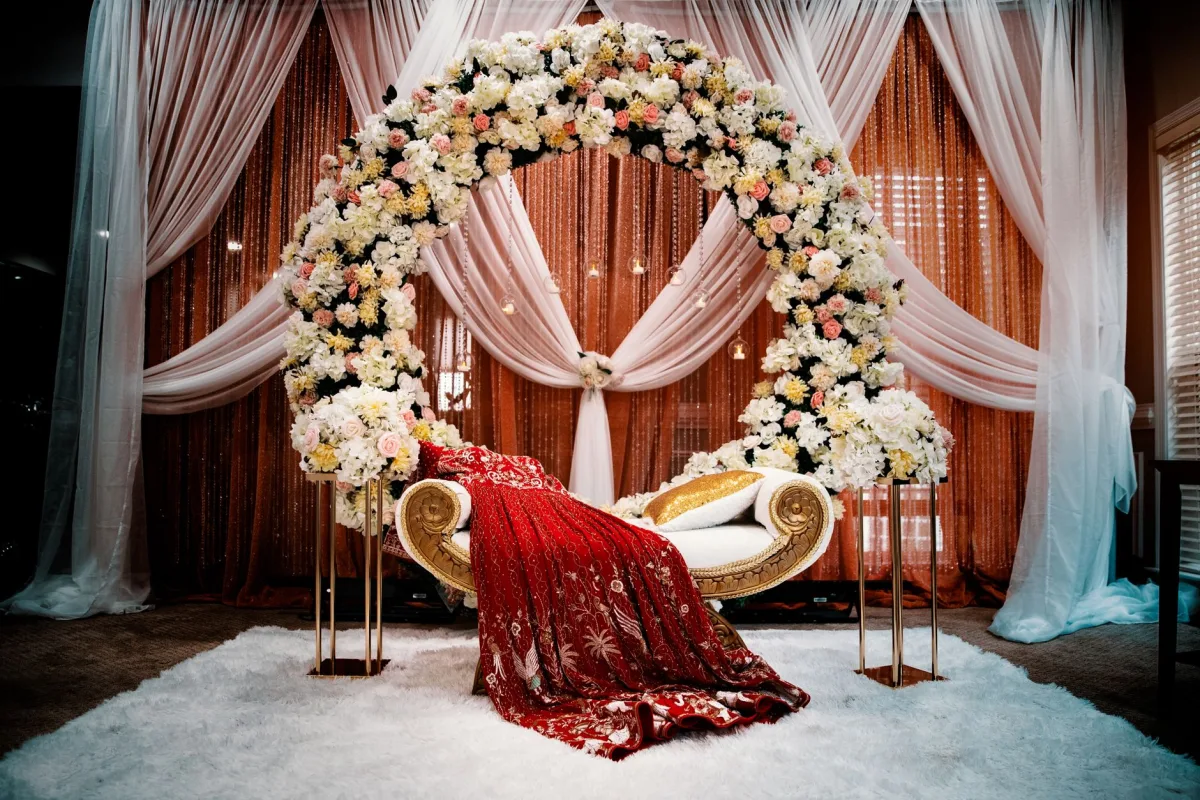
- Draped fabric. Flowing silk, chiffon or velvet swagged across the wall creates instant softness and depth. Pleated backdrops in a single rich colour photograph beautifully and hide a plain venue wall.
- A floral wall. A dense panel of blooms or greenery, real or faux, is the modern signature backdrop. A monochrome rose wall reads as luxury; mixed wildflowers read as relaxed and romantic.
- Geometric frames and arches. A circular moon gate, a hexagon frame or a classic arch gives the couple a defined shape to sit within. Wrap it in greenery and a few statement blooms.
- Hanging installations. Suspended flowers, cascading greenery, or ribbons and paper cranes descending from above draw the eye upward and work brilliantly under high ceilings.
- Natural and rustic. Wooden panels, a living-plant wall, pampas grass or a dried-flower arrangement suit barns, gardens and boho themes.
- Light and neon. A curtain of fairy lights, a starlit drape or a tasteful neon phrase such as the couple's names turns the backdrop into its own light source.
Whatever you choose, match its scale to the room. A grand floral wall that anchors a large banquet hall can swamp a small venue, while a delicate frame that charms an intimate space vanishes in a cavernous one. For coordinating the rest of the room to your backdrop, our guide to wedding decorations ties it all together.
Floral and greenery ideas
Flowers are where the stage gains texture, and where costs climb fastest, so spend them where the camera looks. The craft of arranging them, floristry, is worth a real florist's eye for a stage of any size.
- Asymmetric clusters. Grouping blooms heavily on one side of an arch and trailing them down is more modern and more photogenic than a symmetrical border.
- Cascading garlands. Greenery ropes and marigold strings framing the backdrop add movement and are relatively economical per metre.
- Statement centre arrangement. One large focal arrangement behind or above the couple's seats gives the stage a clear heart without covering every surface.
- Faux where it counts. High-quality faux flowers for the huge backdrop wall, real flowers for the arrangements guests pass close to, is a common way to cut cost without looking cheap.
If you want to lean fully into blooms, our dedicated ideas for wedding floral decorations and the pillar guide on choosing a wedding florist go further on sourcing and seasonality.
Lighting ideas that change everything
Lighting is the most underrated element and often the cheapest transformation available. The same plain stage can feel like a nightclub, a garden at dusk or a candlelit chapel depending on how it is lit.
- Uplighting. Colour-washing the backdrop from floor level adds depth and lets you match the stage to your palette in seconds.
- Fairy-light curtains. A wall of warm pin-lights behind sheer fabric is the single most reliable way to make any backdrop glow.
- Spotlighting the couple. A soft key light on the seats keeps the couple bright in photographs even when the room is dim.
- Candles and lanterns. Clusters of candles at the stage edge, real or flameless, add intimacy and warmth at almost no cost.
- Projection and monograms. A projected pattern or the couple's initials cast onto the backdrop personalises the stage without any physical build.
Ideas by theme and budget
The same four layers dress up or down to suit any style and any wallet. A few coordinated directions to pull from:
Classic and grand
Draped ivory fabric, a symmetrical floral arch, gold accents and a pair of ornate chairs. Timeless and formal.
Rustic and boho
Wooden frame, pampas grass, dried blooms, warm fairy lights and macrame. Relaxed, natural and forgiving of a modest budget.
Modern minimalist
A single bold colour drape, one asymmetric floral cluster, clean geometric frame and dramatic uplighting. Striking with fewer elements.
Traditional festive
A mandap or ornate canopy, marigold garlands, rich jewel drapes and layered lighting. Vibrant and rooted in ritual.
On a tight budget, spend on lighting and one strong backdrop element, and keep flowers concentrated rather than spread thin. On a generous budget, invest in a florist-built installation and layered lighting, and let the seating and small details follow. Either way, keep costs anchored to your wider plan with our wedding budget checklist, and consider a statement wedding arch as the backbone of the whole stage.
The bottom line
A wedding stage is not one decision but four working together: a backdrop that sets the theme, florals that add texture where the camera looks, lighting that supplies the mood, and seating that anchors the couple in the frame. Match the scale to your room, lean on lighting when the budget is tight, and choose a style that feels like you rather than a rented default. Do that, and the backdrop behind your happiest photographs will be one you are proud of for a lifetime.
Frequently asked questions
How much should I spend on wedding stage decoration?
There is no fixed figure, because it depends on venue size, your theme and whether you use real or faux flowers and hired or built elements. A sensible approach is to treat the stage as a priority line in your overall decor budget, since it is the most photographed backdrop, and to spend first on lighting and one strong backdrop element before adding extras. Get itemised quotes and match them to your total decor budget.
What is the easiest way to make a plain stage look special?
Lighting. A wall of warm fairy lights behind sheer fabric, uplighting in your palette, and a soft spotlight on the couple will transform a bare stage faster and more cheaply than flowers alone. Add one focal element, such as a draped backdrop or a single asymmetric floral cluster, and even a modest stage reads as designed rather than empty.
Should I use real or artificial flowers on the stage?
Many couples use both: high-quality faux flowers for the large backdrop wall, where guests view from a distance, and real flowers for the arrangements people pass close to. This keeps the cost down without looking artificial. Real flowers offer scent and subtle movement; good faux ones survive heat and long days without wilting, which matters for an all-day event.
How do I choose a stage design that suits my venue?
Match the scale first. A large floral wall that anchors a grand banquet hall will overwhelm a small room, while a delicate frame that charms an intimate space disappears in a large one. Consider ceiling height for hanging installations, the wall behind the stage, and how the couple's seats will read from the back of the room, then scale the backdrop and lighting to fit.
What is a mandap and is it a kind of stage?
A mandap is the canopied structure, usually supported by pillars, under which Hindu wedding rites are performed. It functions as a decorated stage: it is the focal point the ceremony is built around, dressed with drapes, florals and lighting much like any wedding stage. Many South Asian couples treat mandap decoration as their central stage-decoration decision.